
Santorini isn't Mykonos, and that's the entire point. Come here to feel something, not to be seen.
It's a Tuesday in late September, around 7:40pm, and I'm on the caldera path between Firostefani and Imerovigli, walking slowly because everyone is walking slowly. The light has gone that specific Aegean amber that photographers chase and rarely catch. A couple ahead of me — two men, maybe mid-fifties, clearly on anniversary trip number something — are holding hands and stopping every thirty seconds to let one of them line up another photo. Nobody is looking. Nobody is looking because nobody on this path is doing anything else. The whole corridor is couples, mostly, and a disproportionate number of them are same-sex, and the only thing that registers is the light and the volcano and the faint smell of wild thyme drifting up the cliff face alongside somebody's grilled octopus from 300 meters below.
This is the Santorini I keep coming back for. Not the Instagram version — the actual one, where the island has been quietly, professionally, almost aggressively welcoming same-sex couples for so long that the welcome has stopped being a feature and become the water. There's a reason I gave this one a 7.9 on my Traven-Dex, and a 9.5 on Destination specifically: the place is, objectively, one of the most beautiful things humans have ever built on top of something nature tried to destroy. The 1627 BCE eruption blew the center of the island into the sky, and what was left behind is the caldera — and on its rim, people eventually built whitewashed cube-villages that photograph like a fever dream.
Where it gets honest is the Pulse — I gave it a 4.0, and I stand by it. Santorini is not Mykonos. There is no circuit party, no dedicated gay beach thumping until sunrise, no drag brunch on every corner. Tropical Bar up in Firostefani is the island's most consistently documented gay-friendly venue, and the Fira nightlife strip from Koo Club down to Enigma is mixed and welcoming rather than explicitly ours. If you're coming for the scene, take the ferry to Mykonos and live your life. If you're coming for the romance, the food, the volcano, and a sunset that will actually change how you think about light — stay here. Both trips are valid. They're just different trips.
What Santorini does better than almost anywhere in the Mediterranean is hold the tension between commerce and genuine beauty without letting either one win. Yes, Oia in August is a cruise-ship scrum. Yes, you'll pay €28 for a mediocre caldera-view Greek salad if you're not paying attention. But walk inland to Pyrgos for dinner at Selene, or down 300 steps to Amoudi Bay for grilled fish at sea level, or pour yourself a glass of Assyrtiko on a balcony at golden hour, and you understand why the gays have been booking honeymoons here for forty years and why, since February 2024, they've been booking actual weddings too. Come here to feel something. That's the assignment.
The stuff your travel guide buries on page 47
Here's the headline: as of 2026, Greece recognizes same-sex marriage and equal adoption rights, and has since February 2024 — the first Orthodox Christian-majority country to get there. That's not a footnote. If a destination wedding with the caldera as your backdrop has been the dream, the paperwork finally matches the photos. Local wedding planners have been booking queer ceremonies for years; now the state does too.
On the legal ledger as of 2026: civil partnerships, adoption, joint parental rights, and broad anti-discrimination protections all apply. Gender recognition runs on self-ID under Law 4491/2017 — no medical gatekeeping required. EU anti-discrimination directives apply in full, and no US, UK, Canadian, or Australian government has issued LGBTQ+-specific advisories for Greece. For the full legal picture and advocacy context, ILGA-Europe – Greece Country Overview tracks Greek policy in detail, and Transgender Europe (TGEU) is the go-to for trans-specific legal guidance.
Now the cultural reality, which is where Santorini gets interesting. The island's economy runs on international tourism — approximately 70 direct flight routes in peak season, international crowds saturating Oia and Fira — and that has produced a culture of practiced, largely unremarkable acceptance along the caldera rim. Peak season, June through August, is so international that the LGBTQ+ travel experience generally feels seamless. Shoulder months (May, September) are quieter, cheaper, and equally welcoming — and you can actually watch the Oia sunset without standing on a stranger's head.
PDA comfort appears to scale with geography. In Oia, Fira, and the beach strip at Perivolos, same-sex couples holding hands on the caldera promenade reads as unremarkable. Kamari skews a touch more family-oriented — still comfortable, just read the room. The further inland you go — Pyrgos, Megalochori, Emporio — the more traditionally Greek Orthodox it gets. Residents are warm, but the culture isn't wired for overt same-sex PDA the way a Consell de Cent terrace in Barcelona is. Discreet affection off the main tourist trail is the move; the architecture and food are worth the minor recalibration. For any equal-treatment complaints while in Greece — including matters of sexual orientation or gender identity — the Greek Ombudsman – Equal Treatment Authority is a legitimate, independent government authority with actual enforcement powers, not just a sympathy hotline.
Pro tip: Book cave hotels in Oia or Imerovigli absurdly far in advance — Andronis, Canaves, Katikies fill months out and are perennial favorites with LGBTQ+ couples celebrating milestones. Many properties here quietly facilitate proposal logistics with zero fuss and zero raised eyebrows.
Pro tip: Pull euros from an ATM in Fira before heading to the beaches or inland villages — some beach bars at Perivolos and smaller tavernas in Pyrgos and Megalochori still run cash-only, and the nearest ATM can be an awkward taxi ride away when you're already settled into your sunbed.
What it actually feels like on the ground
Holding hands in Oia and Fira: Along the Caldera Promenade in Fira, through Oia's kalderimi lanes, and down the Fira-to-Imerovigli clifftop path, same-sex couples holding hands generally draws no meaningful attention. A reader told me the stretch from Fira through Firostefani to Imerovigli is practically a pilgrimage for LGBTQ+ couples — more same-sex pairs hold hands along that corridor than almost anywhere in the Aegean. It's not policy. It's the vibe the place has cultivated over decades.
Hotel check-in: Caldera-rim boutique hotels in Oia, Imerovigli, and Firostefani are the most design-forward and the most LGBTQ+-attentive in their service culture — staff are typically trained, multilingual, and untroubled by same-sex couples booking one bed. Mass-market hotels near Kamari and Perissa are professional and friction-free, but the attentiveness gap is real and you feel it.
Taxis and transport: Fira's taxi scene can be chaotic in peak season — fixed zone rates to Fira from the airport, but elsewhere it's metered and the queue at the Fira taxi rank gets brutal. Use the KTEL bus from the Fira station (€1.80, cash only) for beaches and villages, or book hotel transfers in advance. No reported pattern of driver hostility toward LGBTQ+ passengers.
Beaches and public spaces: Perivolos on the south coast is the most relaxed and unpretentious stretch for LGBTQ+ visitors — beach bars like Wet Stories pull a young international crowd where nobody appears to be tracking who you're with. Red Beach near Akrotiri is a natural stunner and generally comfortable. Kamari skews more family; behavior is fine, atmosphere is slightly more mixed.
Late night in central Fira: The main strip from Koo Club toward Enigma is reliably welcoming — on a July Saturday it reads as about as gay-friendly as anywhere in Greece outside Athens. Standard late-night instincts apply after midnight: the strip can get rowdy with international stag parties, and that's a volume-and-alcohol issue, not an LGBTQ+-targeted one. Stick with your group, watch your drink, call it a night when the vibe shifts.
The port-to-Fira route: The path between the old port and Fira — 427 steps or the cable car — gets brutally crowded at sunset and is a genuine pickpocket corridor. The concern here is emphatically not your identity; it's your phone and passport. Bag zipped, phone pocketed, full stop.
Trans travelers: Greece's self-ID framework (as of 2026) covers gender recognition without medical requirements, and trans travelers generally move through Santorini's heavily touristed zones comfortably. Visits to traditional inland villages may encounter limited familiarity with trans identities — observational, not typically hostile. For trans-specific legal and practical guidance before you travel, Transgender Europe (TGEU) remains the resource; for healthcare and social services accessible from anywhere in Greece, PRAKSIS – Healthcare & Social Services Greece handles remote queries.
Verbal harassment risk: Generally low in tourist zones. Santorini's economy depends so completely on international visitors that overt hostility would be economic suicide, and residents appear to know it.
Healthcare: The General Hospital of Thira in Fira is the island's main medical facility. For anything serious, patients are typically evacuated to Athens — which makes comprehensive travel health insurance non-negotiable, not optional.
Pro tip: There are no dedicated LGBTQ+ emergency services on Santorini. The nearest community infrastructure is in Athens — approximately 45 minutes by plane — and Athens-based organizations can provide remote guidance if something goes sideways.
The queer geography
Oia
The postcard. Oia sits at the island's northern tip, a cluster of whitewashed Cycladic cubes and blue-domed churches draped along the caldera rim like something a set designer would get fired for overdoing. Walk the kalderimi — the cobblestone alleys worn smooth by centuries of donkey traffic — and you'll pass boutiques, cave hotels tunneled into the cliff, and the ruins of the Oia Venetian Castle (Kastro) at the far end, where the world's most famous sunset happens nightly. Descend roughly 300 steps to Amoudi Bay for grilled octopus at Dimitris Ammoudi Fish Tavern, pulled straight off fishing boats, and a caldera-level swim off flat volcanic rocks. Oia is also the village named most often in LGBTQ+ travel media as the island's premier destination for same-sex honeymoons — the sunset pilgrimage at the Kastro ruins draws a disproportionately queer-leaning crowd purely on aesthetic self-selection. Arrive 90 minutes early, claim a wall perch, bring a bottle of Assyrtiko, and surrender to the spectacle.
Fira (Thira)
The capital, and the island's nerve center. Fira perches on the caldera rim with the volcano laid out below and the Aegean blazing beyond it. The main square, the cable-car descent to the old port, the Museum of Prehistoric Thera, and a densely packed grid of restaurants, cocktail bars, and boutiques all operate within walking distance. The nightlife strip — running roughly from Koo Club south toward Enigma Club — is where the island actually stays up past midnight. It's not a dedicated gay district, but on a Saturday in July it reads as welcoming in that breezy European "we don't care and neither should you" way. Tropical Bar is the island's most consistently documented gay-friendly venue; Franco's Bar has been pouring cocktails to classical music on the cliff since 1976, and Tango Bar pulls a slightly older cocktail-forward crowd nursing their drinks over the view. For planning and up-to-date event info across Greece, Visit Greece – Official National Tourism is the official tourism authority; for connection to the country's queer community calendar, Athens Pride in June is where the wider LGBTQ+ scene concentrates.
Imerovigli & Firostefani
Imerovigli is the highest settlement on the caldera rim — the word means "daywatch," because Venetians used the ridge to spot pirates. Today it's where you come for the most dramatic panoramic views on the island, the hike past Skaros Rock, and the boutique cave-suite hotels that have become quietly iconic for LGBTQ+ honeymoons: caldera-facing infinity pools, small guest counts, service cultures that read a room before you finish saying "we'd like one bed, please." Firostefani sits just below on the same ridge — quieter, more residential, walkable to Fira's nightlife when you want it and retreatable from when you don't. Pro tip: the paved caldera path connecting Fira through Firostefani to Imerovigli is the most romantic stretch of walking on the island. Do it at golden hour.
Perivolos & Perissa
The south coast, and a completely different Santorini. Perivolos and its neighbor Perissa are long, flat black-volcanic-sand beaches lined with beach bars, sunbed concessions, and mid-range hotels — about 4 km of coastline stretching across the island's south. The crowd is younger, more international, more backpacker-to-design-hotel than caldera-rim luxury. Perivolos is the beach cited most often in LGBTQ+ travel guides as Santorini's most gay-friendly stretch of sand; Wet Stories and the surrounding beach bars draw the community without advertising to it. Get your sunbeds claimed before 11am in high season — by noon the good spots are gone and you're stuck next to the speaker stack. For youth-focused advocacy and resources accessible remotely nationwide, Colour Youth Athens – LGBTQ+ Youth Community operates support services from the capital.
Pyrgos & Megalochori
Inland, uphill, and completely worth the detour. Pyrgos is the island's highest village, a medieval Cycladic hill-town wrapped around a Venetian fortress, with views reaching all the way to the sea on both sides. The food scene here is the island's most serious — Selene, founded in 1986, is credited with putting Santorini's fava PDO and white eggplant on the national culinary map, and Santo Wines Winery just outside the village runs the best tasting terrace on Santorini. The Assyrtiko and Vinsanto flight is the move; linger as long as you want. Megalochori below it is smaller and quieter, a warren of wine caves and tiny squares where the pace drops by an order of magnitude. These are traditional Greek villages running on an older frequency than the caldera rim — conservative Orthodox culture, warm residents, but read the room on overt PDA. For destination-specific planning resources, Santorini Official Tourism Portal covers village-by-village logistics.
The experiences worth rearranging your itinerary for
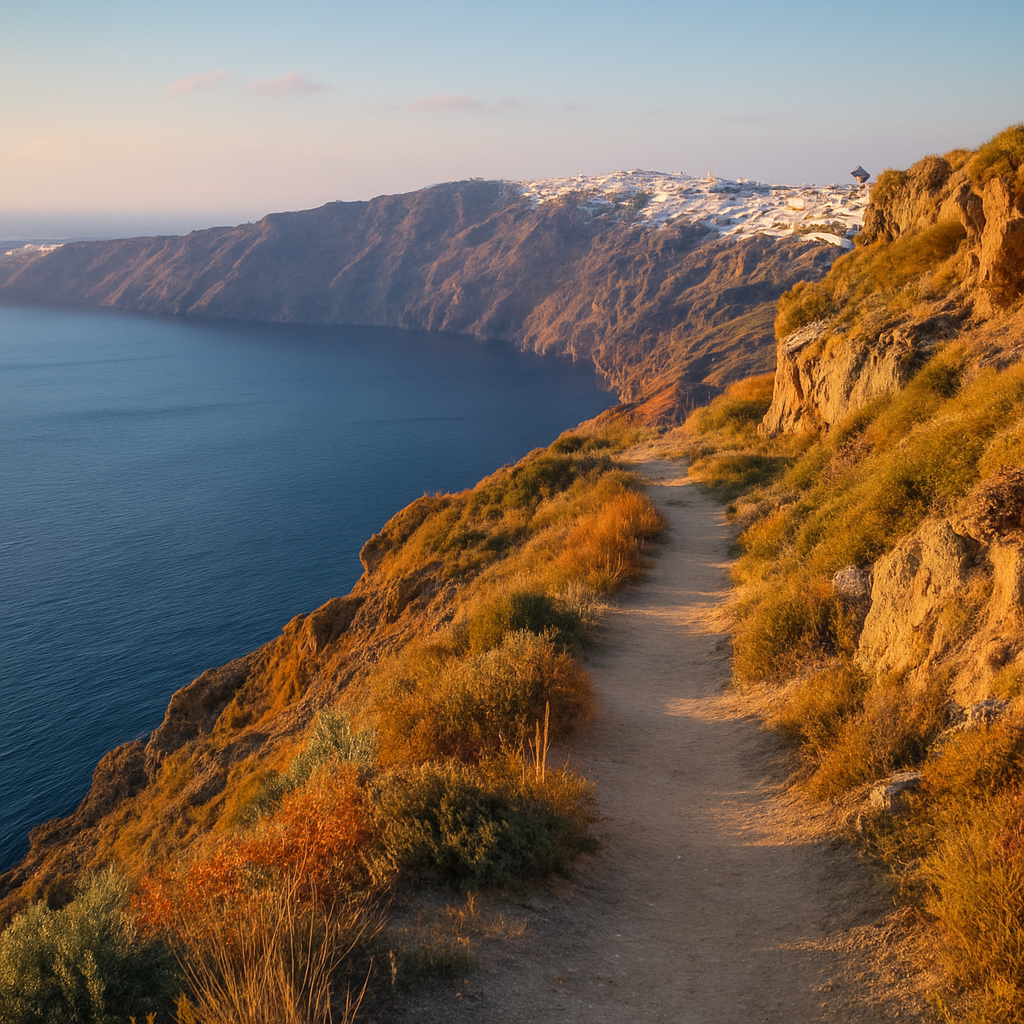
The Caldera Rim Hike from Fira to Oia
About 10 kilometers along a clifftop path with the Aegean dropping roughly 300 meters below you — strenuous, photogenic, and one of the most satisfying walks in Greece. You'll pass through Firostefani and Imerovigli, climb past Skaros Rock, and arrive in Oia just in time to collapse into a cocktail. Start before 8am to beat the heat and the cruise-ship crowds; bring water, sunscreen, and shoes that can actually handle a trail rather than the aspirational ones you packed for dinner.
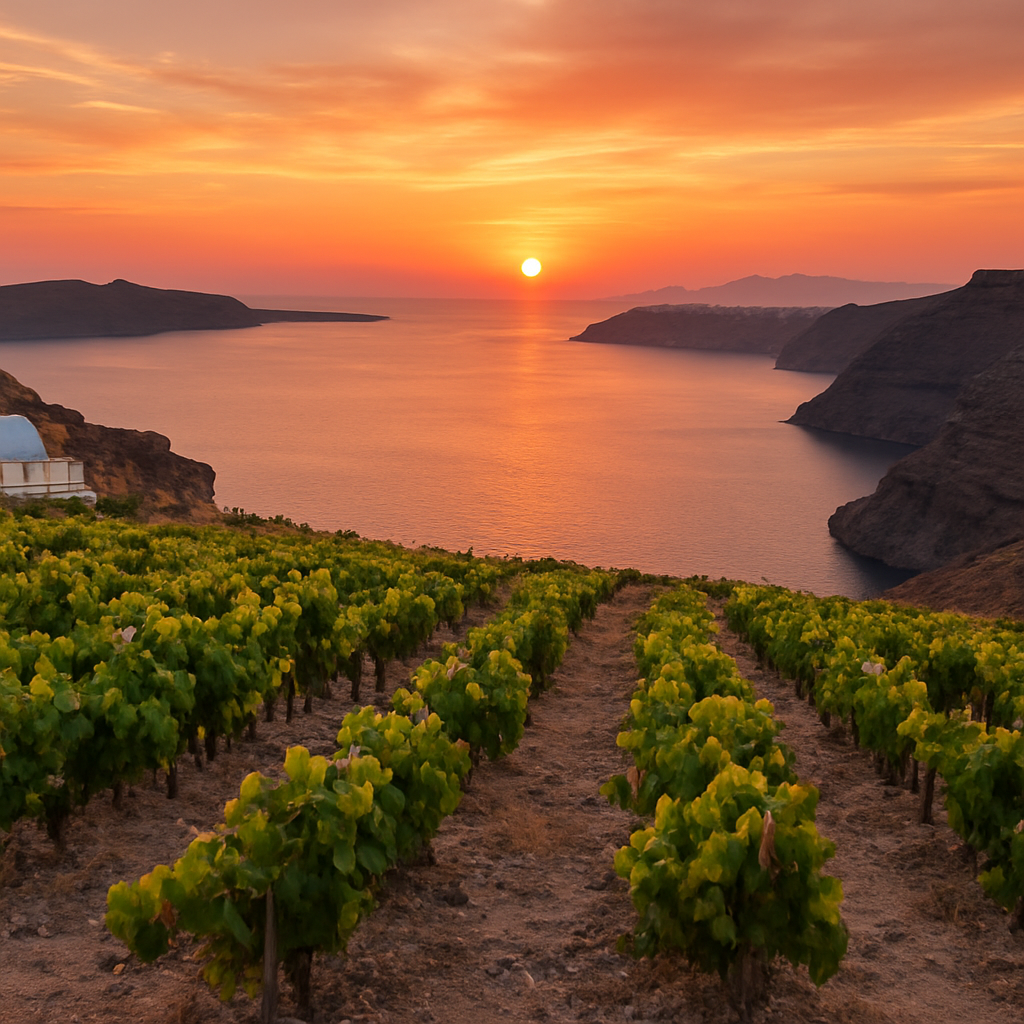
Assyrtiko at Santo Wines for Sunset
Order a glass of Assyrtiko on Santo Wines' caldera-view terrace at golden hour and stay for the entire slow collapse of the sun into the Aegean. The wine is bone-dry, volcanic-mineral, and grown nowhere else in the world; the view is the one you came to Santorini for, with roughly a quarter of Oia's crowd. Stay for a glass of Vinsanto after — the sun-dried, barrel-aged dessert wine that's been the island's other signature for centuries.
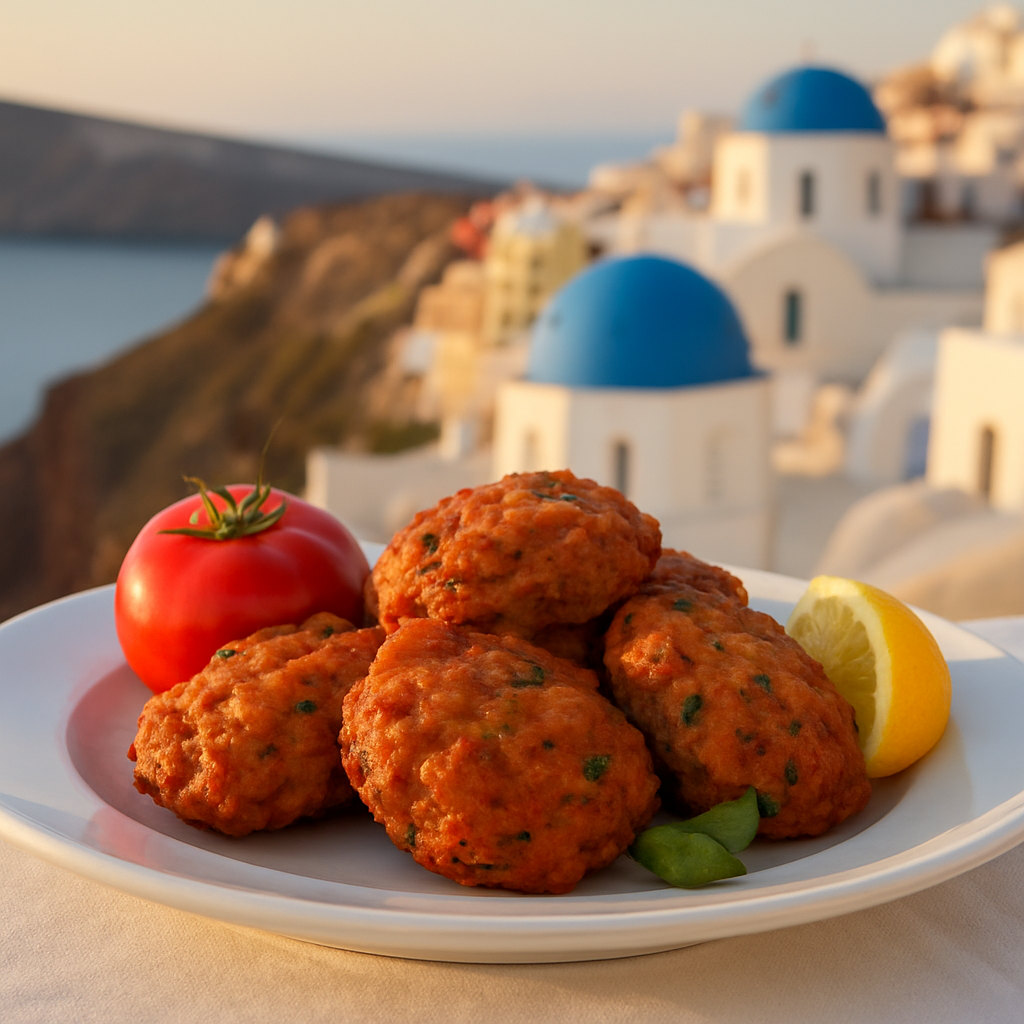
Domatokeftedes at a Traditional Taverna
Santorini's volcanic-soil tomatoes are genuinely unlike anything else — concentrated, intensely flavored, almost sweet — and turning them into domatokeftedes (tomato fritters) is the island's most honest expression of itself. Order them with a side of fava (the creamy yellow split-pea purée that's PDO-protected and unique to Santorini) and a chilled Assyrtiko, and you've got the whole philosophy of the place condensed into one table. Any honest taverna in Fira, Pyrgos, or Megalochori will do them well.
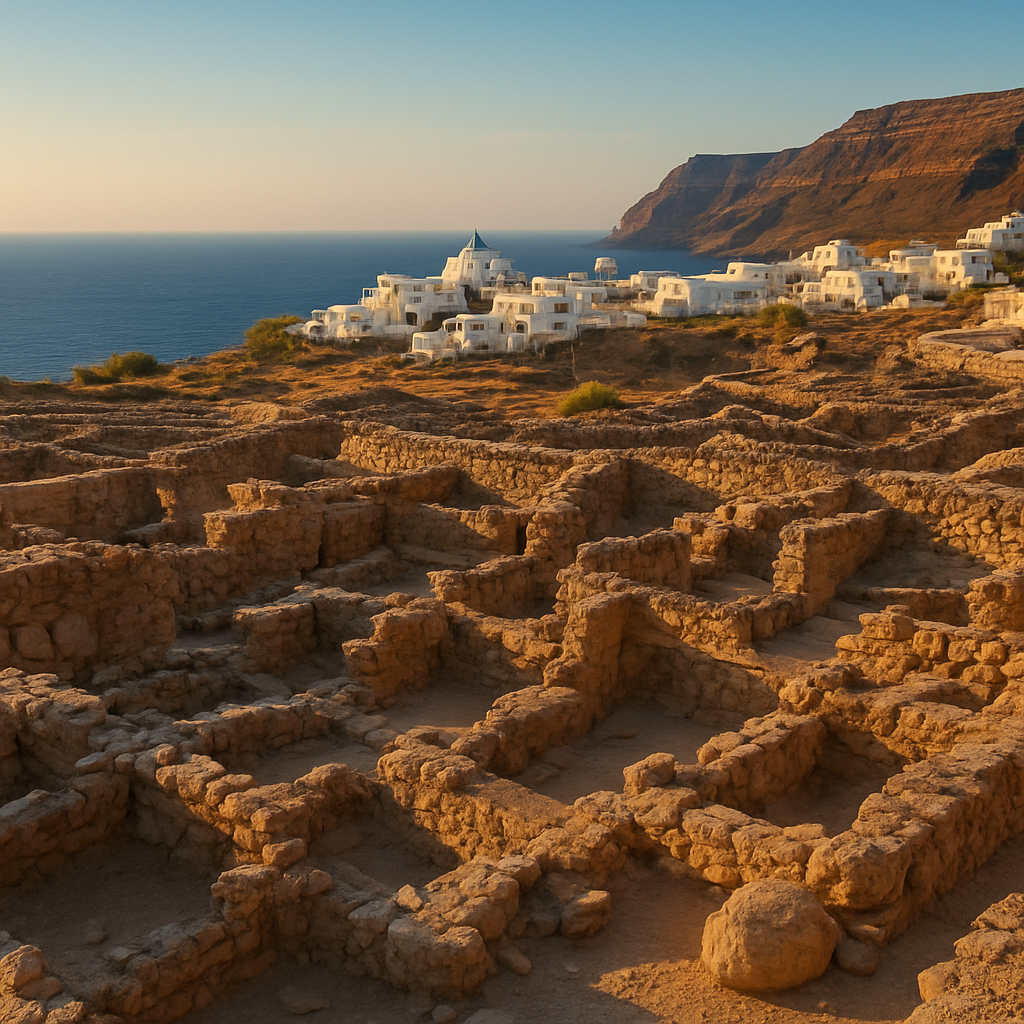
Akrotiri Bronze Age Settlement
Buried by the Thera eruption around 1627 BCE and excavated since 1967, Akrotiri is one of the best-preserved prehistoric settlements in Europe — multi-story buildings, paved streets, drainage systems, and original frescoes still in place under a climate-controlled protective roof completed in 2012. It's the closest thing the Aegean has to Pompeii, with fewer crowds and a more immediate sense of the disaster that shaped the entire island. Pair it with a swim at nearby Red Beach; the volcanic logic of the south coast clicks into place when you do them back-to-back.
Nea Kameni Volcano and the Hot Springs
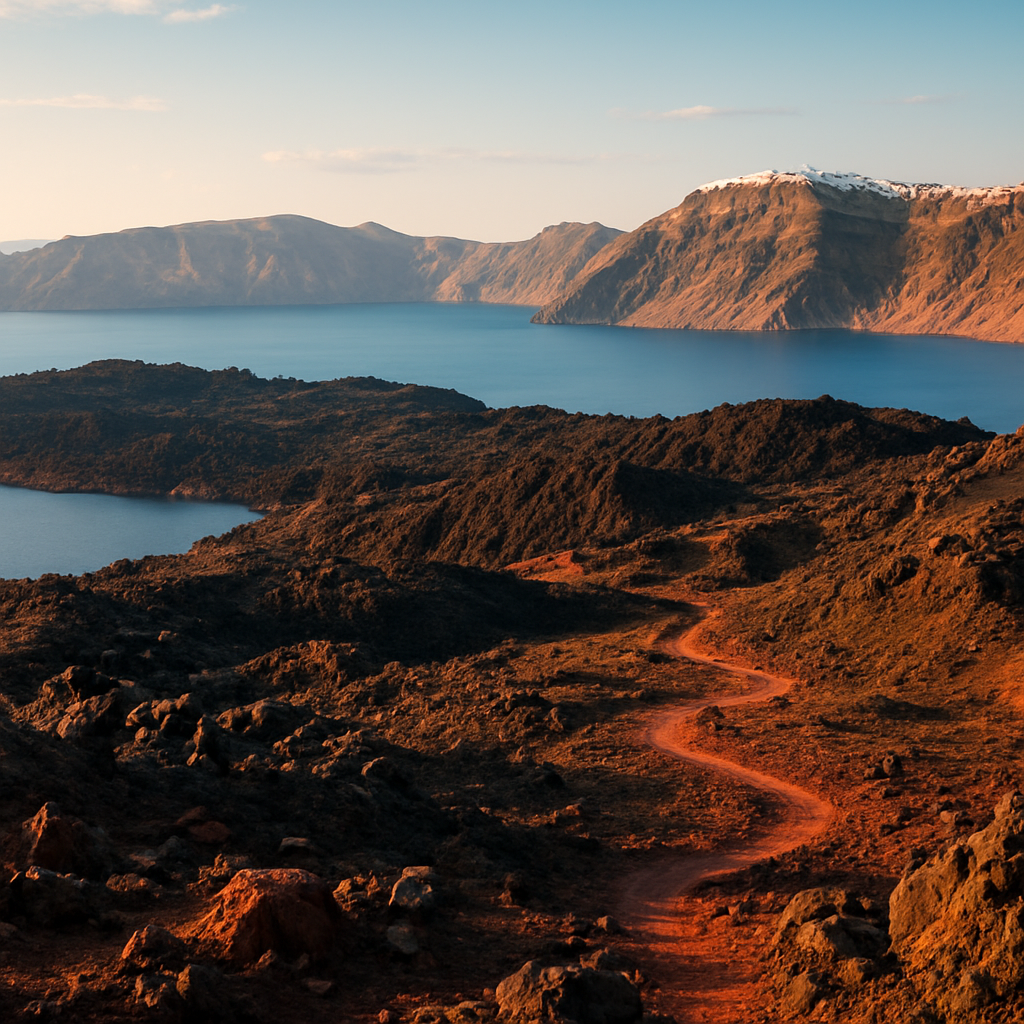
Take the boat from Fira Skala's old port out to Nea Kameni, the active volcanic island at the center of the caldera, hike about 30 minutes to the crater rim, and stand on the geological event that built every view you've been photographing. The standard tour combines this with a stop at the sulfuric hot springs near Palea Kameni — wear a swimsuit you don't love, because the iron-rich water stains everything it touches. The ride back at sunset is its own quiet reward.
The places I actually send people to
Advice that fits how you travel
Santorini is honest about what it is: a romance island. Knowing that going in is actually an advantage when you're traveling solo, because you calibrate correctly and then the place surprises you with how well it works on its own terms. The food, the geology, the wine, the light at 7:30pm — none of it requires a travel companion to land. If anything, doing the caldera rim walk from Fira through Firostefani to Imerovigli completely alone, stopping whenever the view demands it, is one of the better travel experiences in the Mediterranean. You're not the third wheel here — you're the one setting the itinerary.
For social energy, point yourself south. Perivolos and Perissa on the black-sand south coast draw a younger, more international crowd where beach bars like Wet Stories pull in the kind of people who fall into conversation without it needing to be manufactured. The vibe is looser, less curated than the caldera rim, and if you're going to meet someone on this island, this is where it happens. Budget math works in your favor here too — mid-range south-coast hotels run significantly less than cave suites in Oia, and you're steps from the water rather than 300 steps above it. Caveland hostel in Karterados, about 2 kilometers from central Fira, starts from €30/night — one of the only genuine budget options on an island that otherwise refuses to acknowledge budget travelers exist.
Nightlife runs through Fira's central strip. Tropical Bar is the island's most consistently documented gay-friendly venue, and from there the loop through Koo Club and Enigma is mixed, international, and uncomplicated — nobody's tracking who you came with. App culture runs active during peak season (June through August), primarily among visiting travelers rather than a settled local gay community; manage expectations in shoulder months and you'll still find your people. The Akrotiri Archaeological Site, a caldera sailing tour out to Nea Kameni, and dinner inland at Metaxi Mas in Exo Gonia are all experiences that genuinely improve when you're the one setting the pace — no consensus required.
If any island has ever been engineered for same-sex couples, Santorini is making the strongest case. The gays have been booking honeymoons here for decades, and since Greece legalized same-sex marriage in February 2024 — the first Orthodox Christian-majority country to do so — the destination-wedding crowd has caught up. Local wedding planners had been booking queer ceremonies in front of the caldera for years before the law changed; now the paperwork finally matches the photos. PDA along the caldera rim is genuinely unremarkable: through Oia's kalderimi lanes, on the Fira-to-Imerovigli clifftop path, over cocktails at Franco's Bar on the cliff — same-sex couples holding hands is background noise. The island has absorbed decades of this without a second glance.
For accommodation, the boutique cave-suite hotels in Oia and Imerovigli — Katikies, Canaves Oia Suites, Astra Suites — appear in same-sex honeymoon guides repeatedly because the staff have been facilitating proposals and anniversaries for years, and the private-infinity-pool format is built for exactly this kind of celebration. Mystique and Vedema (both Marriott Luxury Collection) bring the added backing of a company with a written non-discrimination policy explicitly covering sexual orientation and gender identity. For something less financially catastrophic, Cosmopolitan Suites in central Fira delivers caldera views from €160/night. The itinerary shapes itself: walk the clifftop path at golden hour, descend 300 steps to Ammoudi Bay for grilled octopus at Dimitris Ammoudi Fish Tavern, book Koukoumavlos for a late dinner, and end with a glass of Vinsanto at Santo Wines while the sun completes its collapse into the Aegean.
One practical note: Perivolos Beach on the south coast is the island's most relaxed setting for same-sex couples who want actual beach time rather than caldera-rim social performance. Wet Stories and the surrounding beach bars pull a young international crowd where nobody is tracking who you came with or what you're wearing. If your idea of a romantic beach day involves genuine peace rather than posing — point the ATV south and stay there until sunset.
As of 2026, Greece recognizes same-sex marriage and equal adoption rights, and LGBTQ+ families traveling here have the same legal standing as any other family structure. That matters at the practical level — hotel check-ins, boat tour bookings, medical forms — and Santorini's thoroughly international tourism culture means it plays out without friction. Staff at caldera-rim hotels have been navigating diverse family configurations for years; you won't need to explain your family at check-in or anywhere else on the main tourist circuit.
The south coast is the most practical part of the island for families with young children. Perivolos and Perissa are long, flat, accessible black-sand beaches backed by beach bars with menus that work for younger eaters — fresh fish, grilled chicken, pasta, and Greek salad universally available. The Akrotiri Archaeological Site is one of the better cultural experiences for kids on the island: a Bronze Age city buried by the Thera eruption approximately 3,600 years ago, with multi-story buildings and original frescoes preserved under a climate-controlled protective roof. Any child old enough to follow a story about a catastrophic volcano will be genuinely engaged. Pair it with a swim at Red Beach just down the coast — the volcanic logic of the south coast clicks into place when you do them together. For families wanting to complete the story, the Museum of Prehistoric Thera in central Fira (€6 entry) houses the original Minoan frescoes from Akrotiri and makes the ruins visit make sense at a deeper level.
One practical caveat: the caldera rim — particularly upper Fira and most of Oia — runs on ancient cobblestone kalderimi paths and cliff-edge stairs that are a serious project with a stroller. Baby carriers are the functional call for caldera exploration; Fira's main commercial strip and the south-coast resorts are considerably more accessible for pushchairs and small legs. Budget-wise, LGBTQ+ families run approximately €185–285/day at the budget tier and €460–740 at the moderate level — south-coast hotels and self-catering apartments bring those numbers down significantly from caldera-luxury pricing, and the beach access from there is genuinely better for families anyway. Rent a car if you're doing the south coast properly: it makes Akrotiri, Red Beach, and Perivolos a single relaxed loop rather than a taxi coordination exercise.
What Santorini actually costs
Flights, visas, and the first 30 minutes
Airport: Santorini Airport (JTR) sits on a narrow plateau in the island's southeast — roughly 15 to 25 minutes from most villages depending on where you're staying and how peak-season traffic is behaving that day. Approximately 80 direct routes operate in peak season, with direct services from London, Amsterdam, Frankfurt, Paris, and other major European cities running May through October. Outside peak season — or if you're traveling from North America, Australia, or Canada — you'll almost certainly connect through Athens (ATH), a 45-minute hop that's almost always cheaper than you expect.
Visa Requirements (as of 2026): EU citizens travel freely under freedom of movement — no visa, no pre-authorization required. US, UK, Canadian, and Australian passport holders are typically admitted visa-free for up to 90 days within a 180-day Schengen period. As of 2026, the ETIAS authorization (European Travel Information and Authorization System) is generally required before arrival for US, UK, Canadian, and Australian travelers — it's an online pre-authorization, not a visa, but it's a step that grounds flights if you skip it. Apply well before your travel dates, not the night before departure. UK travelers should note this applies post-Brexit despite the visa-free entry terms.
Getting from JTR to Your Hotel:
- KTEL Public Bus — €1.80–2.50 to the Fira bus terminal, 25–45 minutes. Cash only. Schedule is limited, particularly for late arrivals. This is the budget move, not the convenience move.
- Taxi — Fixed fare zones; confirm the rate before you pull away. Expect €15–25 to Fira, 15–20 minutes. The taxi queue at JTR in peak season can be a genuine project — factor that into your arrival plan, not after you land.
- Private Transfer — €35–60 depending on destination, 15–20 minutes. Pre-book through your hotel or a local transfer agency. Strongly recommended if you're arriving late into Oia or Imerovigli with luggage that has no business on a cobblestone donkey path at 10pm.
- ATV / Quad Rental — €25–45/day once you've reached Fira; widely used for getting around the island once you're settled. Book on arrival or in advance during peak weeks — they go fast.
Pro tip: If you're checking into a cave-suite hotel in Oia after 8pm in July or August, arrange a private transfer before you land. The Fira taxi situation at peak hours is not the welcome you want after a long travel day.
Traven's seasonal breakdown
The questions everyone asks
Is Santorini safe for same-sex couples?
Can we legally get married in Santorini?
Is there an actual gay scene or gay bars?
When's the best time to go?
Do I need a visa?
How much should I budget per day?
Do I need to rent a car?
Screenshot this before you go
So should you actually go?
Go. Santorini earns every inch of its reputation, and for LGBTQ+ travelers specifically — especially same-sex couples — it's one of the most quietly, completely welcoming destinations in the Mediterranean. You won't find a scene here the way Mykonos delivers one; what you'll find instead is a culture of practiced acceptance along the caldera rim, some of the best cooking in Greece hiding in inland villages, and a volcano that built the most photographed sunset on earth. Come in May, June, or September if you can — skip the July-August crush. Stay somewhere small and caldera-facing if the budget allows, or south-coast at Perivolos if it doesn't. Either way: this is a trip you'll be talking about for years.
Sources & Resources
Official links we reference when compiling this guide. Last verified 2026-04-14.
- Athens Pride (Greece's primary Pride organization)
- Colour Youth Athens – LGBTQ+ Youth Community
- Greek Ombudsman – Equal Treatment Authority
- Human Rights Watch – Greece
- ILGA-Europe – Greece Country Overview
- PRAKSIS – Healthcare & Social Services Greece
- Santorini Official Tourism Portal
- Transgender Europe (TGEU)
- Visit Greece – Official National Tourism