
Positano doesn't have a gay bar. It has a coastline so operatic it makes one feel redundant.
Positano is the gay honeymoon capital of Italy that refuses to brand itself as such, and that's precisely the deal. There's no rainbow crosswalk, no gay village, no bar advertising a bear night — just a vertical village stacked into a cliff that has been quietly hosting same-sex couples since Gore Vidal was writing from up the coast in Ravello. My Traven-Dex of 6.9 reflects the split personality of the place: the destination itself is borderline perfect, the scene is almost nonexistent, and the math only works if you understand what you're signing up for.
I gave it a 9.2 on Destination because the village genuinely earns it. The maiolica dome of Chiesa di Santa Maria Assunta anchoring the skyline. Da Adolfo's red-fish-painted boat leaving Marina Grande at 11am for a pebbled cove with no road access, where lunch is mozzarella grilled in lemon leaves and rosé poured until you've lost the afternoon. The ridge walk down from Nocelle on the Sentiero degli Dei, roughly 1,500 steps and the entire Amalfi Coast laid out below you. These are not consolation prizes. This is the top shelf.
But the Pulse score of 3.5 is just as honest. There is one serious nightclub — Music on the Rocks, cut into a sea cave at the edge of Spiaggia Grande — and it works for a Saturday, but it's the full inventory. No gay bar. No gay district. The single most important planning decision you can make is to stitch Naples into the trip, 90 minutes away by seasonal ferry, where Chiaia and Piazza Bellini run an actual scene and Napoli Pride fills the streets in late June. Positano is the backdrop. Naples is the substance.
What stays with me is the small, specific stuff. Starting the day with a granita at La Zagara under bougainvillea before the sun clears the cliff. Franco's Bar at Le Sirenuse at 7:30pm with the light going amber over the Tyrrhenian and two men at the next table clearly on their honeymoon, clearly unremarkable to anyone working the floor. The walk along the Fornillo coastal path at dusk, past the Torre Trasita watchtower, to a seafood dinner at Lo Guarracino suspended above the water. Positano isn't a city the gays built. It's a city the gays figured out a long time ago — quietly, generously, and without ever needing to make a thing of it.
The stuff your travel guide buries on page 47
Italy sits in an awkward middle place on LGBTQ+ rights, and the Amalfi Coast inherits that ambiguity. As of 2026, same-sex unioni civili (civil unions) have been on the books since 2016, granting most of the legal protections of marriage — but full marriage equality doesn't exist, and joint adoption for same-sex couples remains legally incomplete. Anti-discrimination protections in employment and services are broad; homosexuality has never been criminalized in modern Italian law.
Gender marker change on Italian documents still requires court approval and typically documented medical intervention, which makes Italy one of the more restrictive frameworks in Western Europe on this front. For the full legal picture and case-by-case support, Rete Lenford is the LGBTQ+ legal network worth bookmarking, and Arcigay is the national advocacy organization with a strong Naples chapter covering Campania.
Now the reality on the ground. Southern Italy generally reads more conservative than Milan or Bologna, but the Amalfi Coast has been a gay travel destination since at least the 1950s — Gore Vidal wrote from up in Ravello, and Positano has been quietly hosting same-sex honeymoons for generations. The coast runs on unspoken welcome rather than visible allyship. You won't see pride flags in windows, and you won't need to. Tourism is the economy, and the hotels, restaurants, and boat captains tend to treat every couple the same because causing a scene with paying guests would be economic suicide.
PDA in the village core — Spiaggia Grande, the main shopping lanes, the dehor terraces along Via Positanesi d'America — is generally unremarked. Hand-holding at dinner, a kiss at the beach, checking into a hotel as a couple: none of this tends to raise eyebrows. The calculus shifts once you climb into the hillside residential streets or the inland hamlets of Montepertuso and Nocelle, where tourist traffic thins and more conservative southern Italian norms reassert themselves. Hand-holding is still typically low-risk; overt affection may draw curious looks. Read the room.
One practical note for same-sex spouses traveling on different-surname passports: carry your civil union or foreign marriage certificate. It can smooth the occasional double-bed conversation at smaller guesthouses that haven't quite updated their booking assumptions. Pro tip: pick up a Tessera Arcigay (Arcigay membership card) before you head into Naples — it costs almost nothing and unlocks discounts at affiliated bars and events across the country. Gay.it is the best Italian-language resource for current LGBTQ+ events, and ILGA Europe tracks Italy's rights landscape if you want the broader policy view.
What it actually feels like on the ground
Positano sits reasonably high on my Traven-Dex Chill score — a 6.8 — not because it's a progressive bastion but because it's a tiny tourist-dependent village where nothing goes unnoticed and nothing out of line tends to get tolerated. That said, safety is always neighborhood-specific. Here's the ground-level picture.
Holding hands and PDA: On Spiaggia Grande, the main pedestrian lanes, the ferry piers, and the dehor terraces at restaurants, same-sex couples walking hand-in-hand or sharing a kiss tend to be functionally invisible — the crowd is overwhelmingly international, and few people notice. Once you climb into the residential hillside lanes above the village or into Montepertuso and Nocelle, dial it back. Not because anything is likely to happen — confrontation is very rare — but because you may draw curious stares from older residents and that can make dinner less fun.
Hotel check-in: Generally a non-issue at every property in this guide. From the Relais & Châteaux set at Il San Pietro and Le Sirenuse down to the family-run Hotel Poseidon and the Brikette Hostel, staff are professional and accustomed to international guests. One bed, two men — reports are consistent that nobody blinks.
Taxis and boat transfers: Generally fine. The coastal taxi and private boat scene is a tight economy of repeat-customer operators who live and die by reviews. Behavior is typically courteous. If you want extra peace of mind on a late-night road transfer, book through your hotel.
Beaches: Spiaggia Grande is fine for any couple; Fornillo Beach — the smaller, quieter one a 10-minute coastal walk west — is the one LGBTQ+ travel guides consistently point to as the relaxed, less-regimented option, and it's where I'd tell you to settle in with a book.
Late night: Positano genuinely shuts down early. Music on the Rocks is the one serious club — built into a sea-cliff cave above Fornillo — and it draws a mixed international crowd with no history of incidents I've seen reported. The walk back up the hill at 2am is generally safe; it's just steep.
Trans travelers: Italy's legal framework for gender marker change is restrictive as of 2026, and awareness in non-tourist contexts on the coast can be inconsistent. Tourist-facing businesses in Positano are generally courteous and professional; expect occasional misgendering in small inland hamlets, and plan ID interactions (hotel check-in, ferry ticketing) around that reality.
Verbal harassment: Reports are rare in the village proper. Petty theft — not hate — is typically the primary security concern on the Amalfi Coast during peak summer; watch your bag on the SITA buses and in crowded ferry queues.
If something goes wrong: The local Carabinieri post in Positano is small. UNAR, the national anti-discrimination office, and Arcigay Napoli tend to have far more experience handling LGBTQ+ concerns — they're your first calls. For parent and family support, Famiglie Arcobaleno and AGEDO are the two networks to know across Campania.
The queer geography
Positano is not a city with neighborhoods in the proper sense — it's a vertical fishing village built into a cliff, divided less by districts than by which level of the staircase you're on. But there are distinct pockets, each with a different character, and a few spots on the wider coast worth folding into a trip. A reminder: for any real LGBTQ+ infrastructure — community orgs, a proper gay area, organized events — you need Naples, 90 minutes by ferry. Positano is the backdrop. Naples is the substance.
Positano Centro & Spiaggia Grande
The postcard. Spiaggia Grande is the wide pebble beach you've seen in every Amalfi Coast photo, lined with the striped umbrellas of Chez Black (since 1949) and the multi-level terraces of a handful of family-run institutions. Climb up Via Cristoforo Colombo and the lanes narrow into a maze of boutiques, ceramics shops dressed in maiolica, and lemon-draped staircases. La Zagara, on Via dei Mulini, has been pouring house-made limoncello under a bougainvillea-covered terrace since 1956 — it's the gathering point. Hotel Le Sirenuse has appeared on LGBTQ+ luxury travel lists for years; Franco's Bar on its rooftop is the sunset drink you're going to remember.
Fornillo
The other beach, the better one. A 10-minute coastal footpath west of Spiaggia Grande gets you around the headland past the Torre Trasita watchtower to Fornillo Beach — smaller, pebblier, lower-key, with fewer organized beach clubs and a more local feeling. LGBTQ+ travel writing on the Amalfi Coast has consistently pointed at Fornillo as the preferred beach, and it's where I'd tell you to spend your afternoons. Just above, built into the cliff at the edge of Spiaggia Grande, is Music on the Rocks — Positano's only real nightclub, with a dance floor in a natural sea cave and terraces hanging over the Tyrrhenian. Mixed international crowd, reliably welcoming. Go after midnight.
Upper Positano (Via Pasitea)
The upper curve of the switchback road, where residential life happens alongside the mid-range hotels and the pizzerias that keep the village fed without bankrupting you. This is the part of town where the SITA buses come in, where locals live, and where the views open up over the whole bay. Less touristed, more functional. You'll likely pass through it every day if you're staying in a boutique hotel up here, and the Brikette Hostel — the only real budget option in the village — is in this pocket.
Montepertuso & Nocelle
The hamlets above the village, reachable by the local shuttle or about 1,500 steps. La Tagliata, in Montepertuso, serves a fixed 8-to-10-course Campanian feast, shuttles you both ways, and sits on a terrace with views that will ruin other views for you. Nocelle is where the Sentiero degli Dei (Path of the Gods) trail ends its descent. These are tight, traditional communities with minimal tourist exposure; same-sex couples are generally fine here but a bit of discretion plays better than declaration.
Laurito
A cove about a kilometer south of town, reachable only by boat. This is where Da Adolfo runs its famous red-fish-painted boat service from the main harbor all morning — a beach trattoria serving mozzarella grilled in lemon leaves that is, and I mean this, worth flying for. The cove itself has a loose, bohemian energy that has quietly drawn gay visitors for decades. Gay.it has catalogued the coast's welcoming spots for years if you want a deeper regional read.
Naples — Chiaia & Piazza Bellini (day trip or overnight)
If you want actual gay infrastructure on this trip, this is where you go. Naples' historic center is a dense, theatrical sprawl of baroque churches, pizza ovens, and Spaccanapoli-style lanes barely wide enough for a scooter. Piazza Bellini is one anchor of the city's LGBTQ+ social life, and the Chiaia district around Piazza dei Martiri is the other — the density of gay-friendly bars and clubs is what you'd expect from a city of three million. Napoli Pride runs late June into early July and is worth building an itinerary around if the dates line up. For on-the-ground community support, Arcigay Napoli is the regional chapter to know, and the summer ferry from Positano's harbor makes it a comfortable day trip — though I'd argue for an overnight on either end of your Amalfi stay.
The experiences worth rearranging your itinerary for
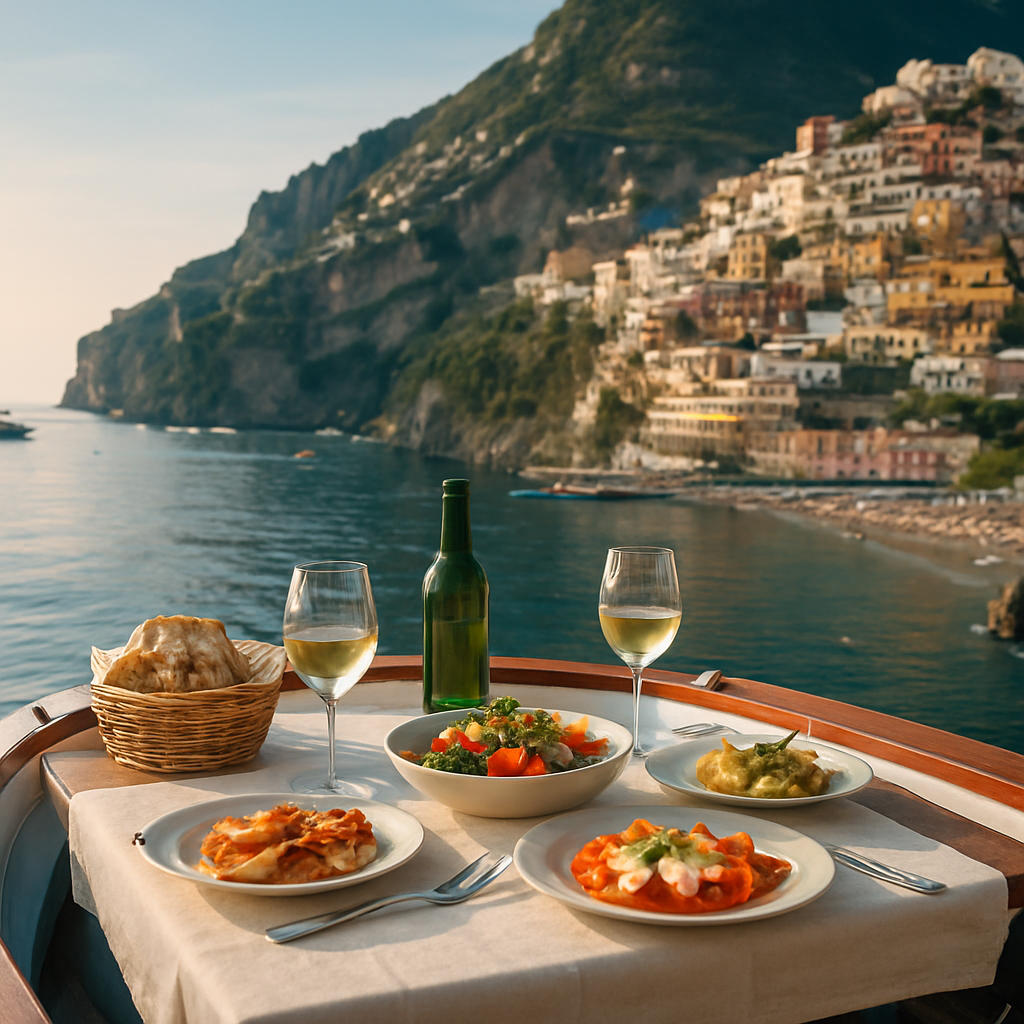
The Boat to Da Adolfo on Laurito Cove
Walk down to Marina Grande before noon and look for the small wooden boat with a red fish painted on the bow. That's Da Adolfo's shuttle, and it's the only way to reach the restaurant — there's no road to Laurito. Ten minutes later you're on a pebbled cove under umbrellas, ordering the mozzarella grilled wrapped in lemon leaves that's been their signature since the 1960s. Get there early and claim a spot before the sun clears the cliff. The meal runs long, the rosé runs cold, and you'll be describing the cheese to people for years.
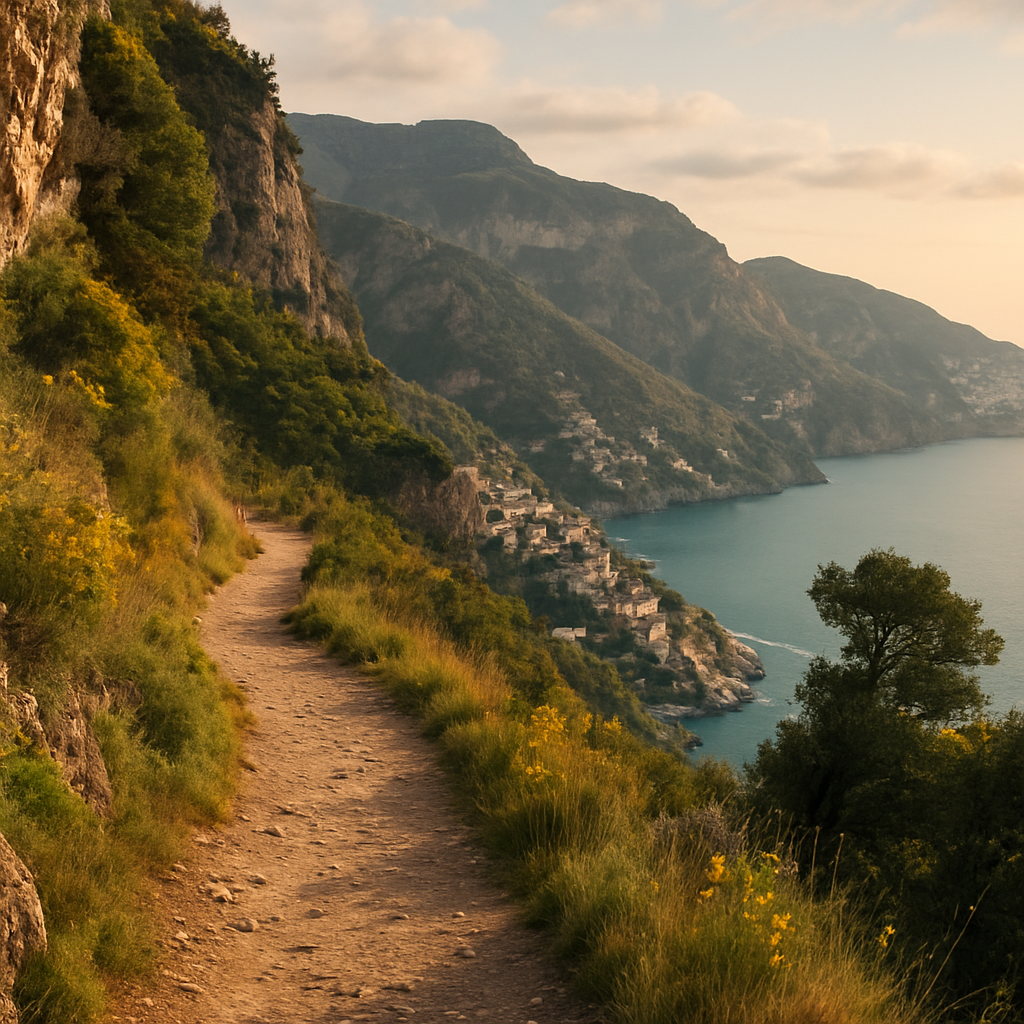
Walk the Sentiero degli Dei
The Path of the Gods is a roughly 7.8km ridge trail from Bomerano down to Nocelle, the hamlet above Positano, with elevations up to about 600 meters. Take the local shuttle up, walk the ridge — the coast opens under you in a way that photographs don't capture — and descend via roughly 1,500 steps, or the seasonal shuttle back into the village if the knees give out. It sits inside the UNESCO-inscribed Amalfi Coast landscape, and it's free. Go early, carry water, wear real shoes.
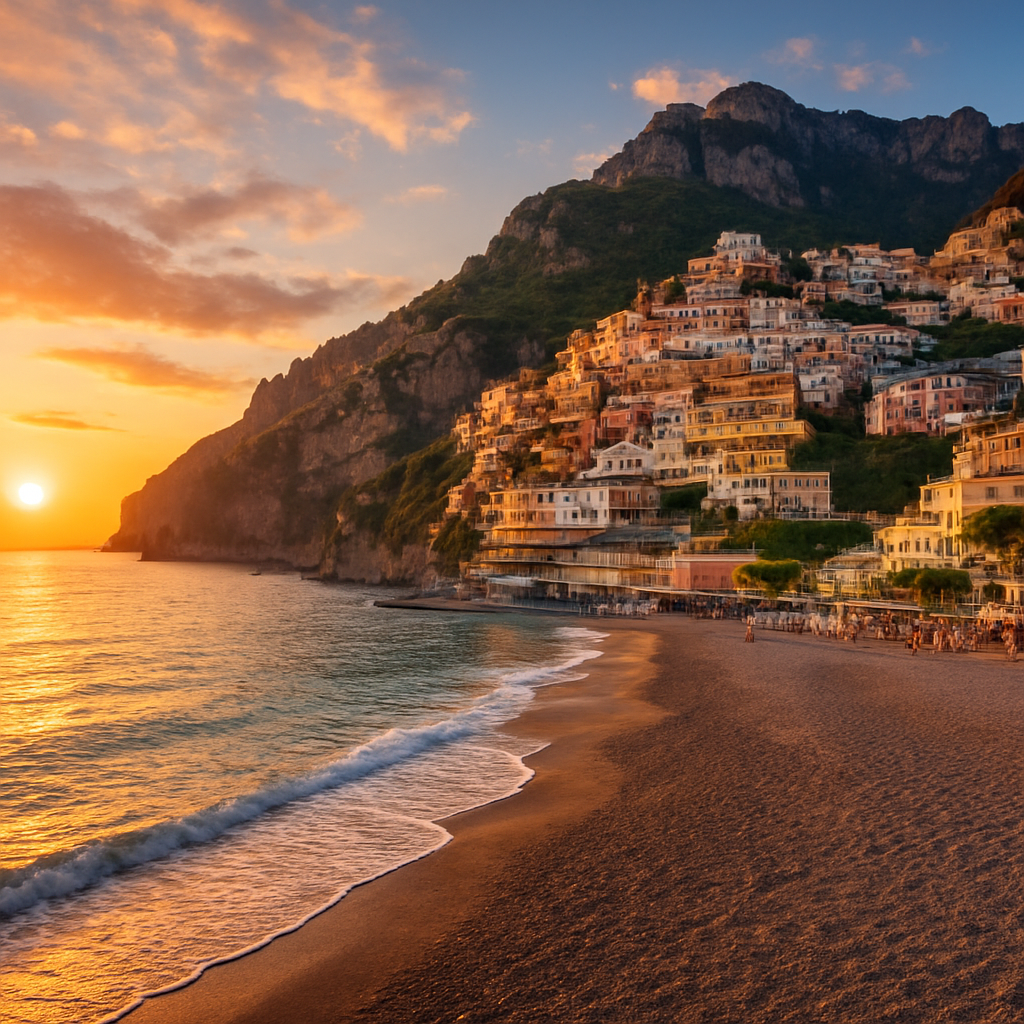
Fornillo Beach at Golden Hour
Walk the coastal footpath west from Spiaggia Grande — about ten minutes around the headland, past the Torre Trasita watchtower — and you'll arrive at Fornillo, Positano's quieter beach. Pebblier, smaller, less regimented, with fewer organized beach clubs and a crowd that actually unwinds. After the day-trippers leave and the light turns amber, order a drink and watch the sun slide behind the cliffs. It's the most romantic hour on the coast, and nobody has to share it with a tour bus.
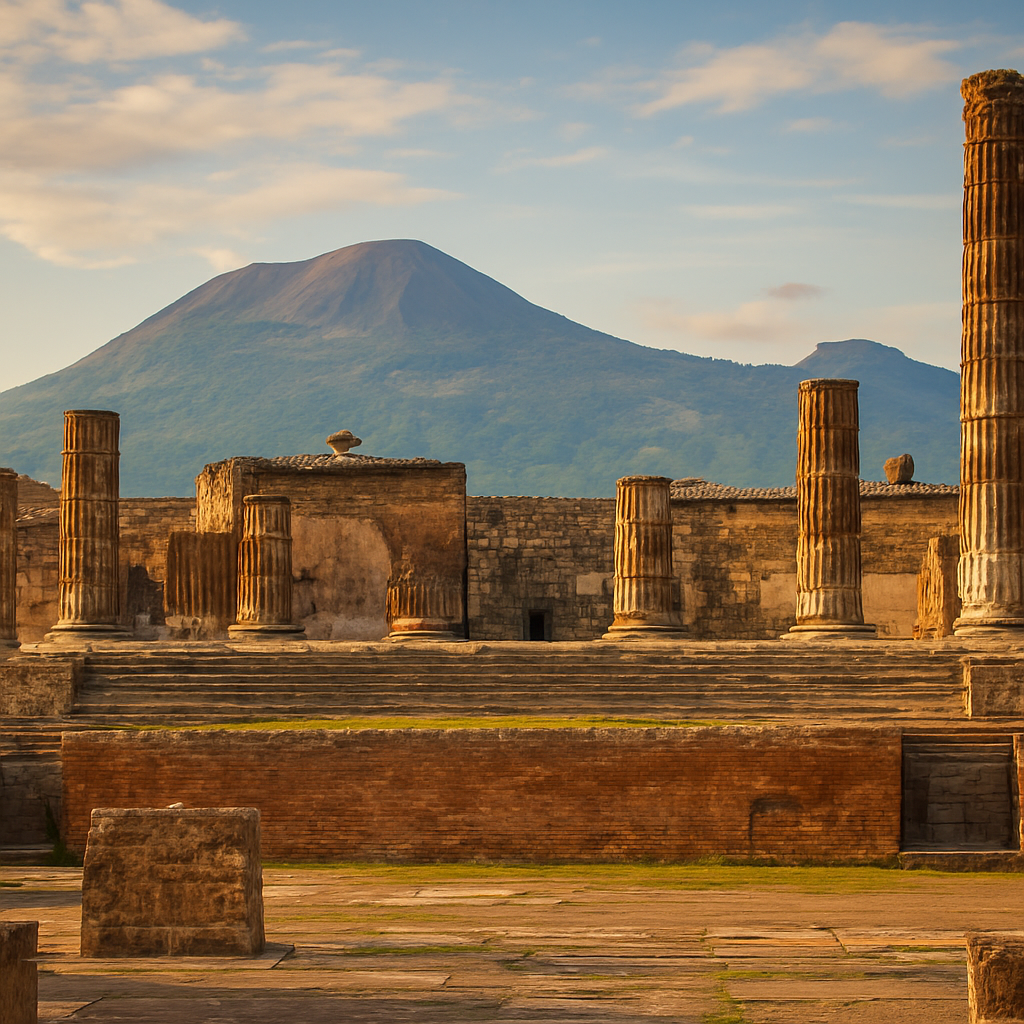
A Day at Pompeii
Approximately 60 km from Positano, accessible by road or by train via Sorrento, a Roman city frozen in 79 CE sits preserved under the layers Vesuvius left behind. You walk the cobbled streets between intact bakeries, villas, and the forum, and the Lupanare still holds its frescoes on the walls. It's one of the most extraordinary archaeological experiences available in Europe; standard entry runs approximately €16–18. Go early to beat the heat and the cruise-ship crowds, and bring water — there's almost no shade on the site.
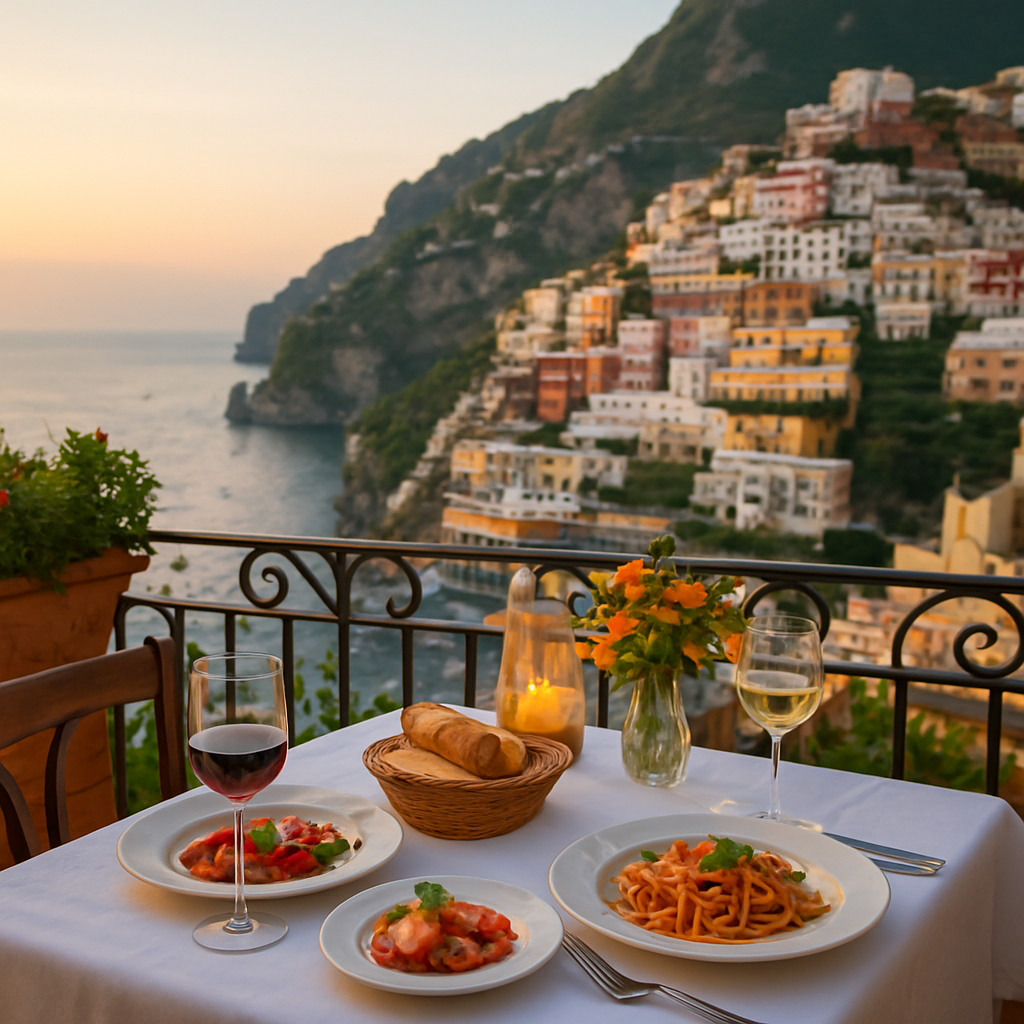
Dinner in Montepertuso at La Tagliata
Up in Montepertuso, roughly 300 meters above the coast, a multi-generational family serves a fixed multi-course Campanian feast on a terrace that opens over the entire Amalfi Coast. They shuttle you up from the village and back down after, one price covers the table, and the courses — antipasti, multiple pastas, a secondo, dessert — keep arriving. Expect house wine poured heavily and pasta made that morning. Come hungry and come with nothing else on the schedule — this is the night.
The places I actually send people to
Advice that fits how you travel
Solo travel in Positano is a particular kind of commitment. My destination score of 9.2 is real — the cliff village, the boats, the light, the food — but my Pulse score of 3.5 tells you just as plainly that the scene here barely exists in the way most gay travelers mean the word. There's no dedicated gay bar. There's Music on the Rocks, Positano's one serious nightclub, built into a sea cave above Spiaggia Grande, with a mixed international crowd that's reliably welcoming — but that's the full nightlife inventory. If you're solo and you need the energy of an actual gay room, plan a day or overnight in Naples, 90 minutes by seasonal ferry, where Arcigay Napoli's listings will tell you exactly where to go.
Budget is the honest challenge, and it shapes the whole calculus. This village prices itself for couples splitting the room; solo travelers absorb that cost fully. The practical answer is Hostel Brikette in Praiano — 5 kilometers east on the SS163, dormitory beds from €28, private rooms available, communal sea-view terrace — with SITA bus service to Positano taking roughly 10 minutes. That same road puts you near Africana Famous Club, a 1960s nightclub built inside an actual sea cave, if you want a late-night option that doesn't require a cliff walk home. On a moderate budget, a solo traveler runs approximately €200–265 per day in Positano proper; the Praiano base brings that down meaningfully, and Grindr and Scruff are active in the region during summer with volume increasing sharply once you're in Naples.
The places solo travelers actually meet people here aren't bars — they're the Sentiero degli Dei ridge trail above Nocelle, the day hydrofoil to Capri, and the communal tables at La Tagliata in Montepertuso, where the fixed-price feast and house wine flowing from the first course tend to dissolve whatever distance strangers started with. In the village, Franco's Bar at Le Sirenuse draws the warmest international aperitivo crowd; go at sunset, dress for it, and let the view do the work. Pro tip: Check Gay.it before you arrive for current events and social meetups across Campania — there's more going on along this coast than the village itself suggests.
Positano has been a same-sex honeymoon destination for longer than Italy has had civil union law. The staff at Le Sirenuse — open since 1951, regularly cited in LGBTQ+ luxury travel media — have been welcoming same-sex couples for over seventy years without anyone needing to make it a formal policy. Check in as two men or two women at any property in this guide and nobody blinks; the coast runs on economically motivated discretion and it works in your favor at every price point. The mosaic pool, the candlelit dining room at La Sponda, and Franco's Bar rooftop do significant romantic heavy lifting on top of it.
PDA is comfortable across the main tourist core — the pedestrian lanes, the terraces along Via dei Mulini, the ferry piers, Spiaggia Grande. The coastal footpath to Fornillo Beach at golden hour is one of the more genuinely romantic walks on the Amalfi Coast: ten minutes around the headland, a quieter crowd, and the cliffs going amber in the light. Dinner at La Tagliata in Montepertuso — the family sends a shuttle down, the courses arrive in waves, and the terrace opens over the entire coast — is the evening you'll still be describing years later. Dial affection back once you're in the hillside residential lanes or the inland hamlets where conservative southern Italian norms reassert themselves; nothing is likely to happen, but discretion plays better than declaration in small-community settings.
A practical note: as of 2026, Italy recognizes unioni civili but not full marriage equality, and same-sex adoption remains legally incomplete. This has no bearing on your daily experience in Positano's restaurants or hotels. If you're traveling on different-surname passports, carry your civil union or foreign marriage certificate — it can smooth the occasional double-bed conversation at smaller guesthouses. For accommodation, Le Sirenuse and Il San Pietro di Positano offer the international clientele and professional standards where the experience is completely seamless; Hotel Marincanto and Hotel Poseidon are the solid mid-range options for couples who want a sea view without the luxury pricing. May–June and September are the sweet spots — the crowd thins, the sea is warm, and the light at 7pm does things to that coastline no other season matches.
One thing worth stating clearly: as of 2026, Italy's framework on same-sex adoption is legally incomplete, and LGBTQ+ families whose parental rights depend on formal recognition should carry documentation — particularly for any medical or emergency situation. In daily practice, no hotel, beach club, or restaurant in Positano is going to question your family structure; the village is tourist-dependent and children are welcomed warmly everywhere. But "warmly received" and "legally protected" are meaningfully different, and you should know which category you're in. Famiglie Arcobaleno and AGEDO are the Italian family advocacy organizations with Campania presence — keep their contacts accessible.
The destination handles families well. Spiaggia Grande has calm, swimmable water with beach clubs renting chairs and umbrellas; Fornillo Beach, a ten-minute coastal walk west past the Torre Trasita watchtower, is quieter and less regimented — better for kids who need room to move. The boat to Da Adolfo on Laurito cove is the kind of experience older children remember for years: a red-hulled wooden boat from the harbor, no road at the other end, mozzarella grilled in lemon leaves when you arrive. For a day trip, Pompeii is approximately 1.5–2 hours by road and excellent for ages 8 and up; standard entry runs approximately €16–18. The Sentiero degli Dei is manageable for physically capable kids around age 10 and up, with a seasonal shuttle available at the Nocelle end when the descent gets long.
The logistical reality deserves an honest mention: Positano is almost entirely stairs and steep lanes, and stroller access is essentially nonexistent. Families with toddlers should stay in the lower village or choose a hotel with a direct beach shuttle — Hotel Buca di Bacco on Spiaggia Grande is the most straightforward option for beach access with young children. Budget realistically: a family of four on a moderate itinerary runs approximately €460–585 per day in Positano; private rental apartments in Praiano or Furore offer meaningfully better value for families than Positano's hotel stock, and the SITA bus keeps you well-connected along the coast. Pro tip: The buses in peak summer get crowded fast — watch your bags and keep young children close at busy stops along the SS163.
What Positano actually costs
Flights, visas, and the first 30 minutes
You fly into Naples International Airport — Capodichino (NAP), the gateway to the Campania coast, with approximately 100 direct routes connecting it to major European hubs including London, Paris, Amsterdam, Frankfurt, and Madrid. Direct transatlantic service to Naples is limited as of 2026; most US and Canadian travelers connect through a northern European hub or Rome. From Australia, connections through a Gulf carrier hub or Rome are the standard routing.
Visas: EU citizens travel freely — no visa, no authorization required. As of 2026, US passport holders are generally visa-free under the Schengen agreement for stays of up to 90 days in any 180-day period. UK travelers are typically visa-free for 90 days in 180, but ETIAS electronic authorization is required before travel as of 2026 — factor that into your booking process well in advance. Australian and Canadian passport holders are generally visa-free under Schengen rules for up to 90 days; verify current ETIAS implementation timelines before departure, as rollout details have shifted before.
Now, the thing nobody puts in the headline: there is no fast way to get from Naples to Positano. The roads are narrow, the coast is essentially vertical, and Positano has almost no parking to speak of. Plan around the transfer time and it becomes part of the trip. Fight it and you'll arrive annoyed at something that has been exactly this beautiful and inconvenient since 1950.
The correct way to arrive — when it's running — is the seasonal ferry from Naples Molo Beverello, operated by NLG or SNAV from April through October. Roughly 70–80 minutes on the water, €20–25, and it sets you down directly in the harbor. This is the one. Book it before you book anything else; it sells out in peak season and nothing about the road alternative will make you feel better about having missed it.
If the ferry isn't an option, the budget route is the Circumvesuviana train from Naples to Sorrento, followed by the SITA bus along the SS163 coastal road — €6–10 total, 2 hours 30 minutes to 3 hours, with hairpin curves that are either cinematic or genuinely upsetting depending on where you're sitting. A private transfer runs €150–220 door-to-door in roughly 1 hour 30 minutes to 2 hours depending on coastal traffic; book with a driver who knows the road. Pro tip: the westbound approach into Positano from the Sorrento side is considerably less harrowing than coming from Salerno — if you have any say in routing, take it.
On renting a car: the data says not recommended, and I agree with the data. Positano has essentially no parking, the lanes were built for donkeys and optimistic Vespa riders, and the road will spend your nerves before you've unpacked. Use the ferry and SITA bus for movement along the coast and leave the car problem to someone else.
Traven's seasonal breakdown
The questions everyone asks
Is Positano safe for same-sex couples?
Is there a gay scene in Positano?
When is the best time to visit?
Do I need to speak Italian?
How much should I budget per day?
Can same-sex couples get married in Italy?
Is Positano stroller-friendly for families with young kids?
Screenshot this before you go
So should you actually go?
Go, but go with your eyes open. Positano isn't the trip where you dance until 4am with three hundred shirtless strangers — my Pulse score of 3.5 is telling you that plainly, and no amount of good lighting changes it. It's the trip where you wake up on a terrace above the Tyrrhenian, take a wooden boat to a lunch that changes your relationship with mozzarella, walk a ridge trail through a UNESCO landscape, and end the night on a rooftop at Le Sirenuse watching the light go down with the person you love. If that's the trip you're after, LGBTQ+ travelers will find this coast welcoming in the quiet, economically motivated, generations-deep way southern Italy does welcome best. Book Naples as a day trip or overnight for the actual community. Book Positano for everything else.
Sources & Resources
Official links we reference when compiling this guide. Last verified 2026-04-14.
- AGEDO — Italian Association of Parents of LGBTQ+ People
- Arcigay — Italy's National LGBTQ+ Organization
- Arcigay Napoli — Nearest Local Chapter to Positano
- Famiglie Arcobaleno — Italian Rainbow Families
- Gay.it — Italian LGBTQ+ News, Culture & Travel
- ILGA Europe — European LGBTQ+ Rights Monitor
- ILGA World — Global LGBTQ+ Rights Organization
- Napoli Pride
- Rete Lenford — Italian LGBTQ+ Legal Network
- UNAR — Italian National Anti-Discrimination Office