
Marrakech doesn't apologize for its contradictions. It hands you cobalt blue at 9am, smoke over Jemaa el-Fna at dusk, and asks if you can hold both at once.
Marrakech is the most contradictory trip I'll send you on this year — a city that will rearrange your nervous system and ask you to keep one part of yourself folded up for the duration. As of 2026, Article 489 of the Moroccan Penal Code criminalizes same-sex acts with up to three years' imprisonment, and that law applies to tourists. There is no marriage, no civil union, no anti-discrimination protection, no legal gender recognition. That is the framework. Everything else — the cobalt blue at Jardin Majorelle at 9am, the smoke from the food stalls at Jemaa el-Fna at dusk, the call to prayer rising over the rooftops at Riad El Fenn — happens inside that frame.
And yet the city's relationship with the gays is older and stranger than any travel guide admits. Yves Saint Laurent and Pierre Bergé fell in love with this place in the 1960s, bought Jardin Majorelle in 1980 to save it from demolition, scattered his ashes here in 2008. The Musée Yves Saint Laurent opened next door in 2017 — Studio KO's terracotta latticework breathing like a living thing — and the Fondation Pierre Bergé–Yves Saint Laurent that runs both is, functionally, the most prominent LGBTQ+ cultural institution on the African continent. None of that is on a plaque. All of it is the truth. My Traven-Dex score of 5.1 is the math of that contradiction — a 9.2 on Destination wrestling with a 1.0 on Legal until they meet, exhausted, in the middle.
The infrastructure that makes this trip work is the riad network. Riad El Fenn in Mouassine, Riad Farnatchi with its nine private plunge pools, Riad 72 in Bab Doukkala, Riad Be Marrakech in Douar Graoua, La Mamounia, Royal Mansour with its 53 individual three-story riads and underground service tunnels — these are properties where the staff have been welcoming international same-sex couples for decades and the discretion is muscle memory. Behind the studded wooden door, you exhale. Guéliz is the daytime room — café terraces, art galleries, alcohol-licensed cafés like Kechmara and Grand Café de la Poste where two men sharing a long lunch register as part of the regular furniture. Hivernage is where the late-night taxi home is well-lit. The Palmeraie is where you rent a walled villa for a week and barely leave.
I scored Marrakech a 9.2 on Destination because the city itself — the medina founded in 1070, the souks, the Atlas snow-capped on the horizon, Essaouira three hours west on the Atlantic — is one of the most extraordinary places I've stood. I gave it a 2.5 on Chill because the bargain you make to be here is real, daily, and not negotiable. Some of you will read that math and book the flight tomorrow. Some of you will read it and book Lisbon. Both responses are correct. What I will not do is pretend this trip is something it isn't.
The stuff your travel guide buries on page 47
Let's start with what the law says, because in Morocco the law is not a footnote. As of 2026, Article 489 of the Moroccan Penal Code criminalizes same-sex acts with penalties of six months to three years' imprisonment plus fines. There is no marriage, no civil union, no adoption pathway, no anti-discrimination protection, and no legal gender recognition. That's the framework. It applies to tourists. ILGA World's Morocco profile and Equaldex both walk through the legal architecture if you want the full picture before you book.
Enforcement is the part most travel writers fudge. Prosecutions of foreigners are uncommon but documented — the 2014 Ray Cole case is the one most often cited, and it was not the only one. The risk is generally not a routine hotel check-in or a meal in a restaurant. The risk is typically a complaint from a local, a confiscated phone with explicit messages, or an entrapment situation that escalates. Human Rights Watch's Morocco coverage and OutRight International track the cases as they surface, and they are worth a read before you go.
Culturally, the gap between law-on-paper and lived reality is wider than the law suggests but narrower than Instagram suggests. Morocco is a Muslim-majority country with conservative public norms; same-sex affection is not visible in daily life, and Moroccan LGBTQ+ people themselves generally operate through private networks rather than public visibility. The neutral Arabic term mithli is what activists use; the Darija slur zamel is what you do not want to hear directed at you. Visiting as a foreigner with a vetted riad and basic discretion is a meaningfully different experience from being a Moroccan navigating this system, and it would be dishonest to pretend otherwise.
Pro tip: ask for une chambre avec un grand lit at the time of booking, in writing, in French — not at check-in. The conversation is smoother in advance, and the right riads (Riad El Fenn, Riad 72, Riad Farnatchi, La Mamounia) won't blink.
PDA comfort is binary here: zero in public, fine behind the studded wooden door of a welcoming riad. That includes Guéliz, that includes the lobby of your five-star, that includes the Atlas day trip. The walled riads and Palmeraie villas are where you exhale. Everywhere else, you are traveling companions.
What it actually feels like on the ground
Holding hands and PDA: Don't. Not in the medina, not in Guéliz, not at Jemaa el-Fna, not anywhere. The law applies on all Moroccan soil regardless of how cosmopolitan a venue feels. In the medina's narrow derbs after dark, walk with purpose and a destination in your head — Marrakech has hustlers and faux guides who target anyone looking uncertain, and a same-sex couple moving hesitantly can attract opportunistic attention that has nothing to do with identity and everything to do with looking lost.
Hotel and riad check-in: At a vetted property, generally a non-event. Riad El Fenn, Riad 72, Riad Farnatchi, Riad Be Marrakech, La Mamounia, and Royal Mansour have all been hosting same-sex couples for years and the staff have long since stopped reacting. At a conservative family-run guesthouse you booked through an aggregator, the same arrival can turn awkward fast. Confirm room type in writing before you arrive.
Taxis and rideshare: Negotiate every taxi fare before you get in, or use Careem or inDrive for metered pricing. Airport transfers run approximately 80–130 MAD on the apps versus 150–200 MAD by official taxi. Drivers are generally professional; this is more about avoiding the fare argument than anything identity-related.
Hammams: This one matters. Traditional public hammams like Hammam El Bacha are gender-segregated neighborhood institutions, and they are not cruising spaces — full stop. Misreading them creates real risk. Hammam de la Rose and Les Bains de Marrakech are legitimate, tourist-friendly experiences worth doing on their own merits. The steam, the scrub, the silence — that's the whole offering. ALCS, Morocco's leading sexual health organization, is the contact for any health issue that comes up during your stay.
Late night: The Hivernage hotel district is the safest area for a 2am taxi home — well-lit, doormen at every corner, international clientele. The medina after midnight is fine if you know your way and have a destination, unsettling if you don't. Riad staff will generally walk you the last few derbs if you call ahead.
Trans and gender-nonconforming travelers: Morocco has no legal gender recognition as of 2026, and risk is meaningfully higher. Passport gender mismatches at hotels and airports can trigger questioning — bring documentation, consider gender-conforming presentation in public, and weight the trip carefully. Rainbow Railroad is the organization to have saved offline before you land — they are the right contact if a situation goes seriously sideways.
Apps: Grindr works in Marrakech. It is also routinely used by police and by people running blackmail and robbery setups. Multiple Moroccan activists have publicly warned travelers off them. If you must use it, keep your profile minimal, disable precise location, never meet in public, and never invite strangers to your accommodation. Grindr's Safety Center has region-specific guidance worth reading before you arrive.
If something goes wrong: your embassy in Rabat is the first call, not the local police. The U.S. and U.K. both have well-rehearsed procedures for travelers caught in 489 situations — see U.S. Embassy Morocco and UK FCDO travel advice for current contact information. Save both offline before you fly.
The queer geography
Marrakech does not have a gay neighborhood. There is no Chueca here, no Le Marais, no equivalent strip of bars with rainbow stickers in the windows. What it has is a network — riads, hotel bars, and a handful of districts where the international crowd is dense enough to give you breathing room. Here's how the city actually divides up.
Guéliz
Guéliz is the French-built ville nouvelle west of the medina ramparts — wide boulevards, jacaranda trees, art galleries, and the only district in the city where you can walk into a café terrace and order a glass of wine in daylight without anyone glancing twice. Avenue Mohammed V is the spine; Rue de la Liberté is where the design crowd drinks coffee. Grand Café de la Poste is colonial Marrakech preserved in amber — rattan chairs, ceiling fans, proper gin cocktails, and a creative European expat clientele that has made this city a discreet haven for a century. Kechmara down the street is the reliable anchor for a slow morning: good coffee, a bookshelf, and the international community drifts through. The Musée Yves Saint Laurent and Jardin Majorelle sit on the northern edge of the district, which makes Guéliz the closest thing Marrakech has to a queer cultural center, even if nothing about it announces itself that way. IGLTA lists several Guéliz properties in its Morocco coverage if you want the curated short list.
Hivernage
Hivernage is the upscale hotel district between Guéliz and the medina — five-star towers, walled gardens, palm-lined avenues, and a doorman at every entrance. La Mamounia is the spiritual center of the district, a 1923 palace hotel that has hosted everyone from Churchill to Yves Saint Laurent and operates with the kind of staff discretion that makes same-sex couples a non-event. Bar Churchill inside the property runs nightly jazz; Le Bar à Vin handles the cellar. Nobu Marrakech opened here in 2022 and connects directly to Pacha Marrakech, which is the closest thing to a comfortably queer-adjacent dance floor in the city after midnight. Theatro works similarly. None of these are gay venues — they are international nightlife venues where, past 2am on a Saturday, the dance floor goes delightfully soft around the edges. Kif-Kif, the exiled Moroccan LGBTQ+ organization based in Spain, is the closest thing to a community resource for context on the local scene's history.
The Medina
The medina is what you came for — the UNESCO-listed walled old city founded in 1070, the labyrinth of souks, the call to prayer at dawn, the smell of orange blossom and grilled lamb at dusk, and the daily transformation of Jemaa el-Fna from a quiet square into a riot of storytellers, gnawa musicians, and food stalls. The riad culture is the LGBTQ+ infrastructure here: Riad El Fenn in Mouassine (co-founded by Vanessa Branson, art collection, rooftop pool), Riad 72 in Bab Doukkala (Italian-owned, intimate, long-established with international queer travelers), Riad Farnatchi nearby (nine suites, each with a private plunge pool), Riad Be Marrakech in Douar Graoua (explicitly gay-friendly). Café Clock in the Kasbah does camel burgers, storytelling nights, and live gnawa music to a habitually liberal expat-and-creatives crowd. Nomad above Rahba Kedima spice market is the contemporary Moroccan rooftop everyone photographs. The medina is conservative on the street and welcoming behind the studded doors — that's the whole geography.
Palmeraie
The Palmeraie is the palm grove on the city's northern edge — walled luxury villas, private pools, Nikki Beach, and Beldi Country Club fifteen minutes south. This is where same-sex couples seeking total privacy rent a villa for a week and barely leave the property. There is no scene here. There is also no friction. For travelers prioritizing decompression over discovery, it's the answer. OutRight International tracks the broader regional context if you want to understand why this kind of walled-private model is the dominant one across North Africa.
Sidi Ghanem
Sidi Ghanem is the industrial design district north of town — converted warehouses, contemporary galleries, furniture showrooms, and the long-term creative expat community that has quietly anchored queer life in Marrakech for a generation. There are no public venues here in the bar-and-club sense. There are openings, dinners in private riads, and the gravitational pull of a community that runs on word of mouth. If you make one good connection at an El Fenn rooftop drink or a Sidi Ghanem gallery night, the rest of the trip writes itself.
The experiences worth rearranging your itinerary for
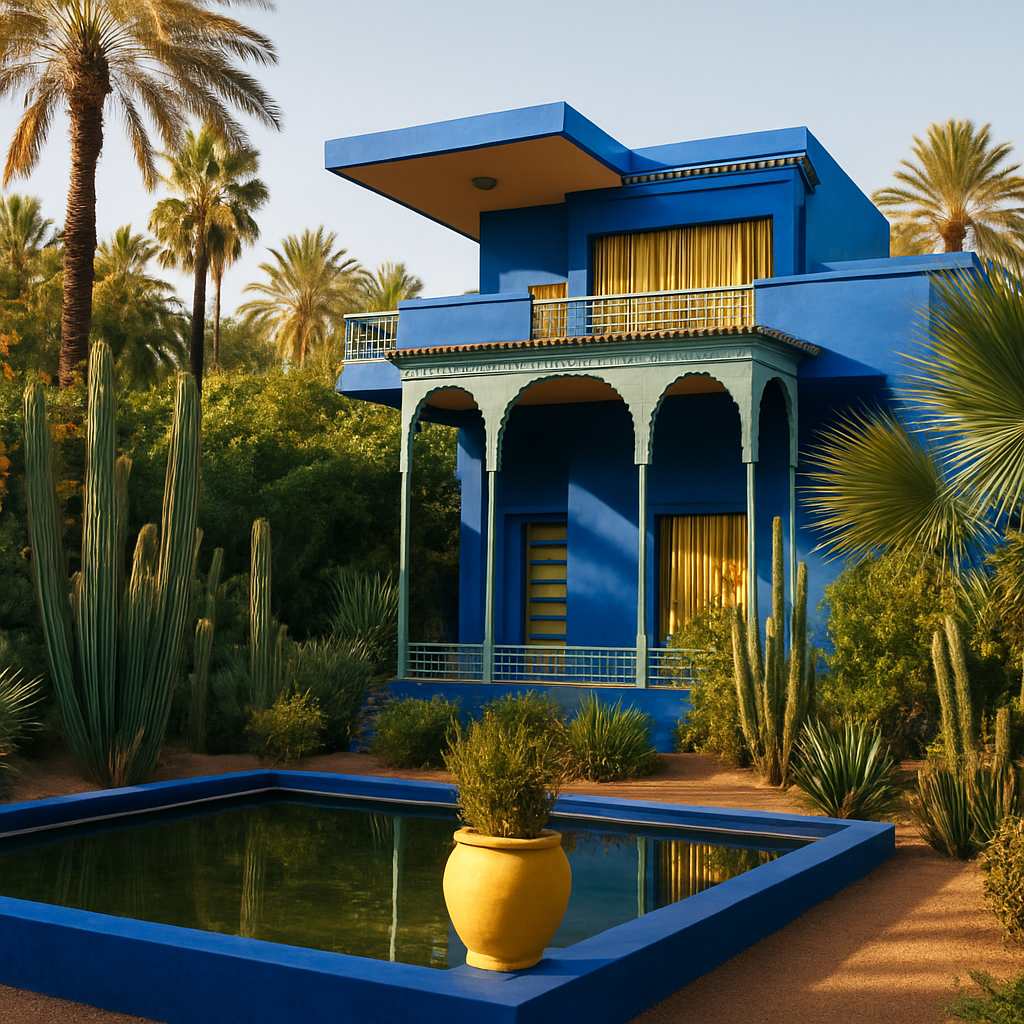
The YSL Pilgrimage: Museum & Jardin Majorelle
Studio KO's terracotta-latticework Musée Yves Saint Laurent opened in 2017 and sits next door to the Jardin Majorelle — Yves Saint Laurent and Pierre Bergé bought the garden in 1980 to save it from demolition, restored it, and scattered Saint Laurent's ashes here in 2008. Buy the combined ticket, arrive at 9am opening before the tour groups, and walk the cobalt-blue pavilions in near-silence.
The building itself breathes — the latticework throws shifting shadow patterns across the floor as the sun moves — and the permanent couture collection puts the full fifty-year arc in dialogue with the city that made him. It is the one Marrakech morning that justifies the whole trip on its own.
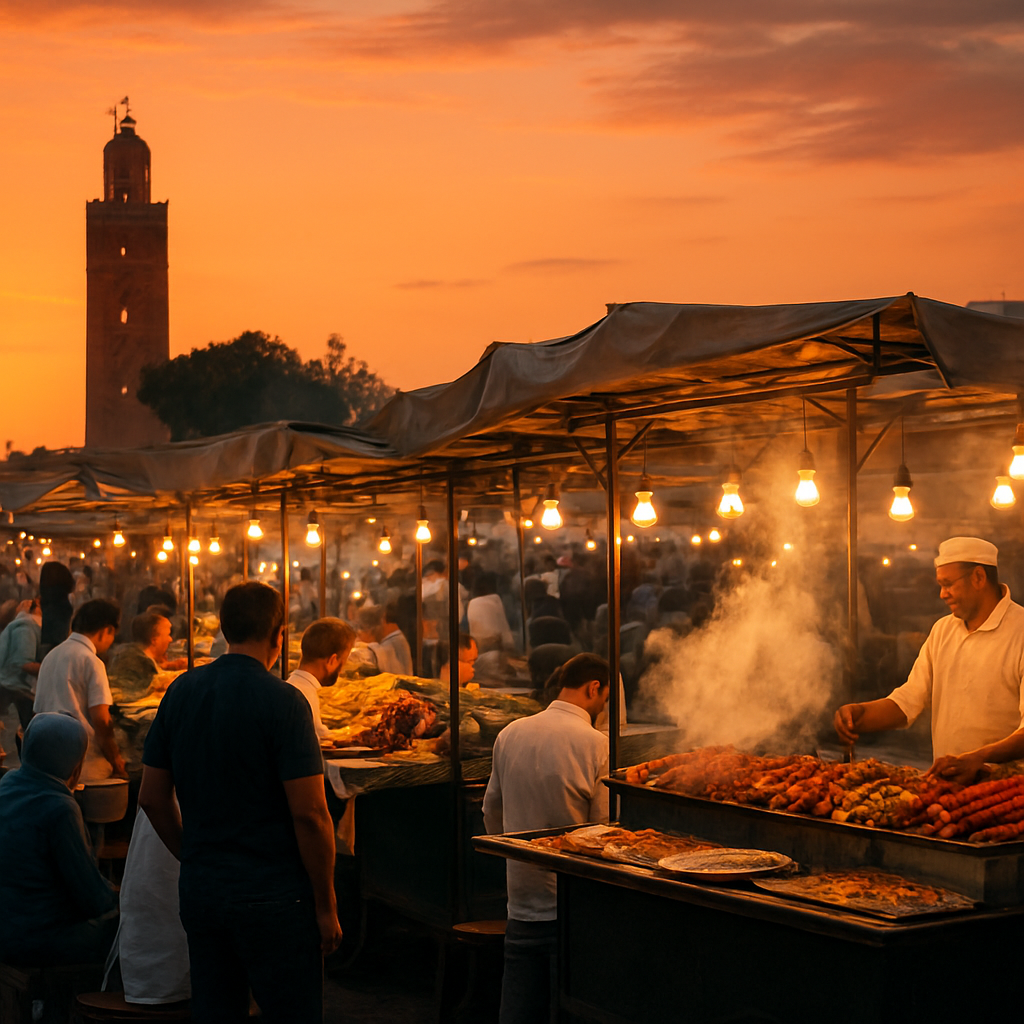
Jemaa el-Fna at Sunset
Jemaa el-Fna is the only cultural space ever inscribed by UNESCO as Intangible Heritage — the designation came in 2001 — and the reason becomes obvious between 6 and 8pm. The square pivots from a quiet rectangle of orange juice carts to a riot of hlaykia storytellers, gnawa drum circles, snake handlers, fire performers, and food stalls boiling lamb heads in copper pots. The smoke from the grills rises straight up against the silhouette of the Koutoubia.
Eat at one of the numbered food stalls — the grilled merguez and the aubergine salad are the moves — and then climb to a rooftop café (Café de France or Le Grand Balcon) to watch the whole square breathe at dusk. Walk it as traveling companions, not a couple. The crowd density is the cover.
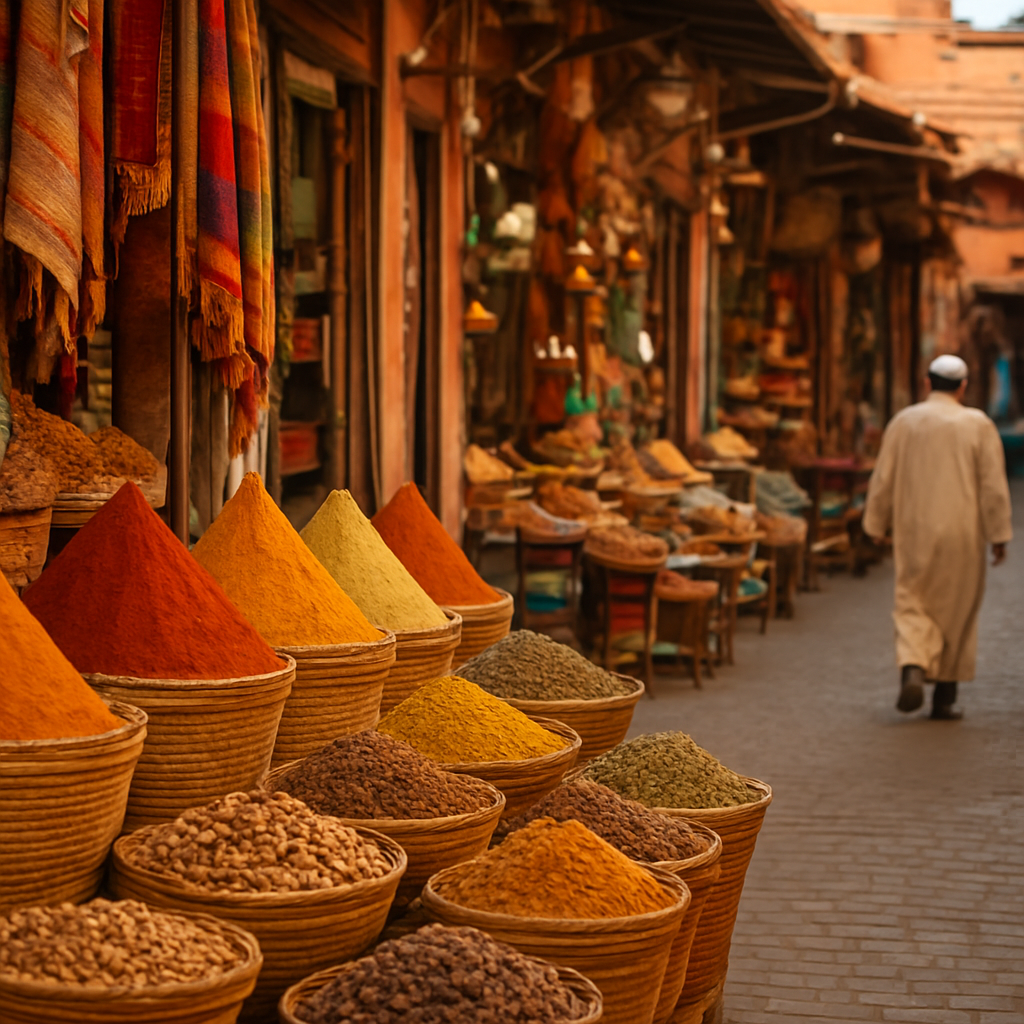
Lose Yourself in the Souks
The medina's souks spread north of Jemaa el-Fna in a labyrinth that has been running on the same logic since 1070 — leather (Souk Cherratine), spices (Rahba Kedima), silver (Souk Semmarine), dyed wool drying overhead in the wool souk, the metal-beating rhythm of Souk Haddadine. Get lost on purpose. The map will not save you and the trying is the point.
Bargain hard — start at a third of the asking price and meet in the middle — and never accept an offer to be guided for free. Carry small dirham bills; nobody, ever, has change for a 200. When the labyrinth gets to be too much, the rooftop at Nomad directly above Rahba Kedima is the exhale.
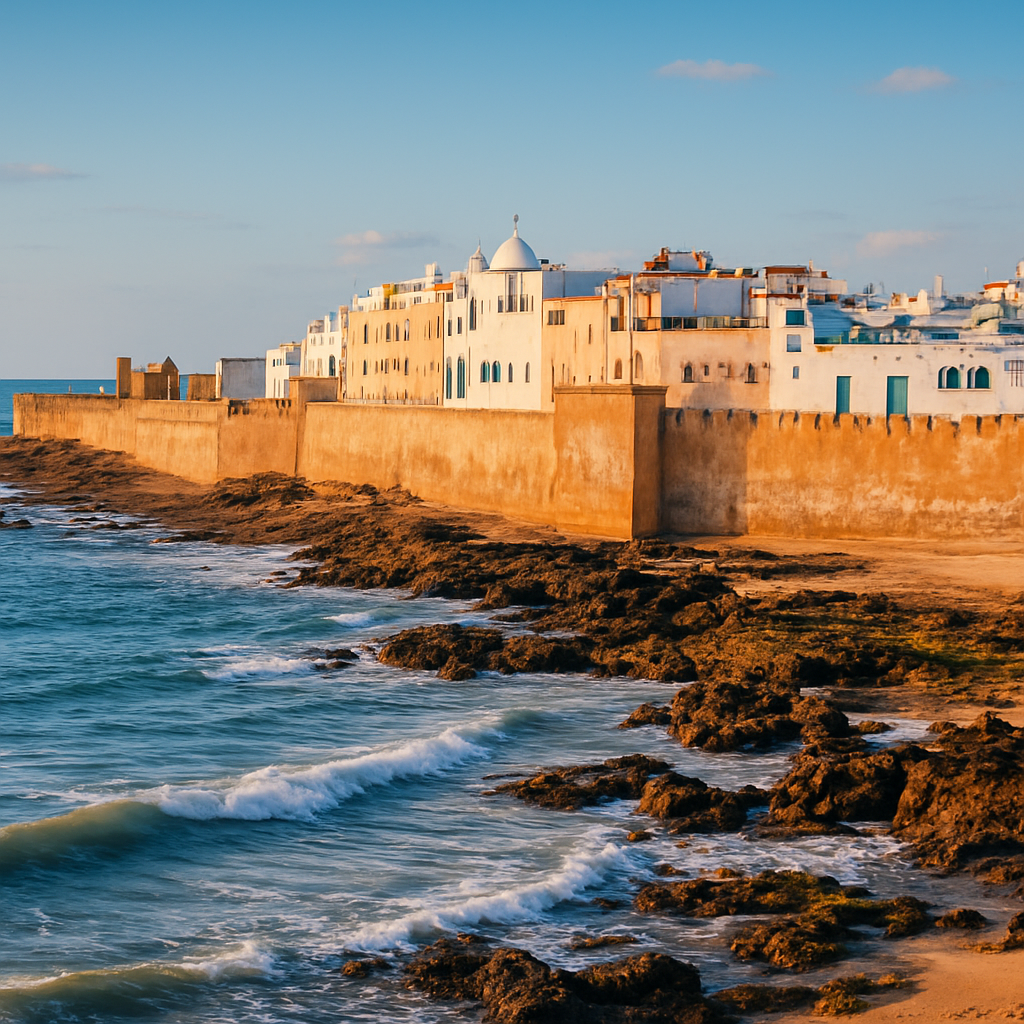
A Day in Essaouira
Essaouira sits 175 km west of Marrakech on the Atlantic — three hours each way by CTM bus or hired car — and the temperature drop alone is worth the trip when Marrakech turns brutal. The fortified medina is UNESCO-listed, the ramparts run straight into the sea, and the port unloads sardines at midday under a permanent sky of circling gulls.
Eat grilled fish from the numbered stalls at the harbor (point at what's just been landed), walk the Skala de la Ville ramparts where Orson Welles filmed Othello, and end the day with mint tea on a rooftop watching the wind kitesurfers carve up the bay. Essaouira's countercultural reputation since the 1960s — Hendrix, the artist colonies — has left a meaningfully more relaxed social atmosphere than anywhere else in the country.
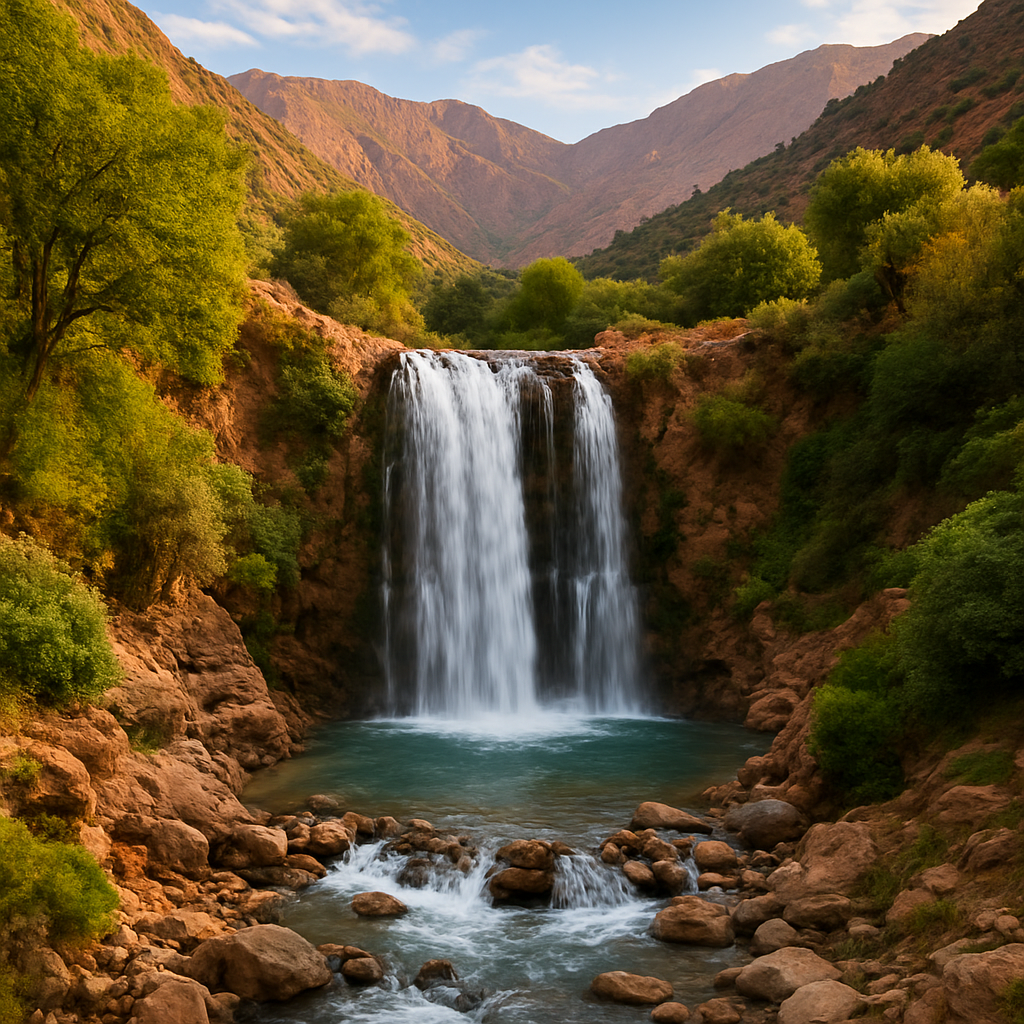
Atlas Foothills & Ourika Valley
The High Atlas begins thirty kilometers southeast of the city, and the Ourika Valley road follows the river through Berber villages to Setti Fatma, where seven cascading waterfalls climb up a rocky gorge that you can hike in an afternoon. Grand taxi from Bab Rob or a guided day tour both get you there for under 300 dirham.
Stop for lunch at one of the riverside restaurants where the tagines are cooked over wood and the tables sit on platforms in the water itself. The drive alone — pink earth, terraced farms, snow visible on the high peaks from October through April — is the kind of scenery photograph cannot do. Rural Morocco runs on different rules than the city, so dress modestly and skip the affection. The landscape does the rest.
The places I actually send people to
Advice that fits how you travel
Solo travel in Marrakech rewards the prepared and punishes the casual — that is the bargain. As a gay man traveling alone, you'll find the city is genuinely stimulating in daylight: long mornings at Kechmara with a coffee and a notebook, an afternoon getting properly lost in the souks, a sunset on the rooftop at Nomad over Rahba Kedima. The international expat density in Guéliz means you can sit at a café terrace for three hours and nobody will register you as anything other than another traveler with a book. That is genuinely useful in a city with Article 489 on the books as of 2026.
Meeting people is where it gets complicated. There is no scene to walk into — no bar where you stop in for a beer and end up at a dinner party. The community is private, riad-based, and runs on word of mouth. If you stay at Riad El Fenn, Riad 72, or Riad Be Marrakech, the rooftop and the breakfast table are where connections happen organically — international queer travelers cycle through these properties constantly. Apps are a different conversation: Grindr works, but there are documented cases across Morocco of police using it for entrapment. If you must use it, keep your profile minimal, disable precise location, and never meet in public or invite strangers to your accommodation.
Budget-wise, solo travel here is generous — approximately 550–850 MAD per day on the budget tier, around 1,400–2,200 MAD moderate. A dorm bed at Equity Point Marrakech in Guéliz runs about €15 a night and the property has documented LGBTQ+ outreach, which at that price point is genuinely the only such option in the city. Pro tip: base yourself in Guéliz if you want walkable bars, alcohol-licensed cafés, and the international community as your daily backdrop. Day-trip into the medina, exhale back into Guéliz at sundown.
For same-sex couples, Marrakech is a study in contrasts — and the contrasts are the whole experience if you set it up right. Behind the studded wooden door of the right riad, you have a private courtyard, a plunge pool, candles at dinner, and staff who have been welcoming international couples for two decades and stopped reacting long ago. Riad El Fenn, Riad Farnatchi (nine suites, each with a private plunge pool), Riad 72, Riad Be Marrakech, La Mamounia, and Royal Mansour (53 individual three-story riads with underground service tunnels so the staff never cross your path) are all properties where same-sex couples register as utterly unremarkable. Confirm une chambre avec un grand lit in writing at booking — the conversation is smoother in advance than at the front desk.
PDA, however, is binary as of 2026: zero in public, fine behind the door. That includes Guéliz, that includes the lobby of your five-star, that includes the Atlas day trip. Not in the medina, not at Jemaa el-Fna, not anywhere. The compensation is that the romantic infrastructure inside the walls is genuinely extraordinary — sunset cocktails on the rooftop at Kabana with the Koutoubia in front of you, a Pierre Gagnaire menu at La Mamounia Italian Restaurant, a long lunch in the courtyard at Le Jardin in Mouassine. The Musée Yves Saint Laurent and Jardin Majorelle together are the pilgrimage — Yves and Pierre Bergé bought the garden in 1980 to save it from demolition, and standing in that cobalt blue at 9am opening, before the tour groups, is the emotional center of the whole trip.
Budgets run approximately 850–1,300 MAD per day on the budget tier, around 2,200–3,500 MAD moderate, and 7,000–14,000+ MAD on the luxury end. The day pass at Beldi Country Club fifteen minutes south of the city — pool, lunch, hammam, no questions — is the move for a romantic afternoon away from the medina. And if you want total decompression, rent a walled villa in the Palmeraie for a week. There is no scene there, which is the point. There is also no friction.
For LGBTQ+ families, Marrakech is the most complicated trip on this site, and I won't pretend otherwise. Morocco offers no marriage, no civil union, no adoption pathway, and no legal recognition of same-sex parents as of 2026. That means your family is not legally recognized while you are on Moroccan soil, and the practical implications matter — bring full documentation for every child (birth certificates, custody paperwork, both parents' passports), and be prepared for the fact that some staff at smaller properties may not understand the family structure. The vetted international properties (La Mamounia, Royal Mansour, Riad El Fenn, Selman Marrakech with its 100-metre pool and working Arabian stud farm) are where this part of the trip stops being a daily conversation.
Practically, Marrakech is a wonderful kid city if you pick the right base. The medina is sensorially overwhelming in the best way for older children — Jemaa el-Fna at sunset with the storytellers and snake charmers and food stalls is genuinely thrilling, and the souks reward curious kids if you keep them close. The Ourika Valley day trip with the seven waterfalls at Setti Fatma is a great half-day for energy burn-off. Beldi Country Club's day pass — pool, gardens, lunch, fifteen minutes from the city — is the reset valve. Strollers do not work in the medina derbs; consider a soft carrier for younger kids.
The honest assessment: families with two moms or two dads are received warmly inside the walls of the right properties, and as traveling adults with children in public spaces. Public displays of affection between parents are off the table, including in Guéliz — the law applies regardless of family structure. Budgets run approximately 1,400–2,000 MAD daily on the budget tier and around 3,500–5,500 MAD moderate. If your family is comfortable with the trade-off — extraordinary cultural experience in exchange for serious public discretion — Marrakech rewards the visit. If that trade-off doesn't sit right with you, that is a completely valid read. Both responses make sense.
What Marrakech actually costs
Flights, visas, and the first 30 minutes
Airport: Marrakech Menara International Airport (RAK) sits roughly 6 km southwest of the medina — close enough that a delayed flight doesn't ruin your first night.
Direct routes: Approximately 80 direct routes connect Marrakech to European hubs and select long-haul cities. From London (Gatwick, Heathrow, Luton, Stansted): ~3.5 hours on easyJet, Ryanair, and British Airways. From Paris (CDG, Orly): ~3 hours on Royal Air Maroc, Air France, and Transavia. From Madrid and Barcelona: ~2 hours on Ryanair and Iberia. From New York (JFK): no direct service — typically one stop via Casablanca on Royal Air Maroc (~9 hours total). From Toronto: typically one stop via Montreal or a European hub. From Dubai: ~8 hours direct on Emirates.
Visa requirements (as of 2026): Travelers from the US, UK, EU, Canada, and Australia are typically permitted visa-free entry for stays up to 90 days. Your passport generally needs at least six months of validity remaining beyond your entry date and one blank page. Always confirm current requirements with the nearest Moroccan consulate before booking — entry rules can shift.
Airport to city: The official airport taxi is fixed-rate at 150–200 MAD (surcharge after 8pm) and runs 15–25 minutes — agree the fare before you get in. Bus 19 (the Airport Express) leaves every 20 minutes for Jemaa el-Fnaa and Gueliz, costs 30 MAD, and takes 30–45 minutes. Careem and inDrive run app-based rides for approximately 80–130 MAD in 15–25 minutes — cheaper than the official taxi, though the pickup zone can shift.
Pro tip: if you're staying inside the medina, book the riad transfer (200–350 MAD). A driver meets you at arrivals with a porter, walks you through the derb labyrinth, and handles the bags — well worth the premium on your first night when you have no idea where anything is.
Traven's seasonal breakdown
The questions everyone asks
Is Marrakech safe for LGBTQ+ travelers?
Do I need a visa to visit Morocco?
Can same-sex couples book a room together at a riad?
Is it safe to use Grindr in Marrakech?
When is the best time to visit Marrakech?
How much should I budget per day?
Are there any gay bars or LGBTQ+ venues in Marrakech?
Screenshot this before you go
So should you actually go?
Should you go? With clear eyes and a vetted riad — yes, and you'll spend years afterward trying to explain to people who haven't been why you keep going back. The cobalt blue at Jardin Majorelle, the rooftop at Nomad over Rahba Kedima at sunset, the Pierre Gagnaire menu at La Mamounia, the morning the call to prayer wakes you in a Mouassine courtyard — that is a stack of memories you cannot assemble anywhere else on earth. But the trade-off is real and it is daily: zero PDA in public as of 2026, serious caution on apps, the law applying on all Moroccan soil regardless of how cosmopolitan a venue feels. If you can hold both truths at once — the magic and the math — Marrakech rewards the visit beyond what its 5.1 suggests. If the trade-off doesn't sit right with you, that is a completely valid read, and there is no shame in choosing the city that lets you exhale fully. Both responses make sense. LGBTQ+ travelers should weigh this one carefully and book it deliberately, not impulsively.
Sources & Resources
Official links we reference when compiling this guide. Last verified 2026-04-30.
- ALCS (Moroccan Association Against AIDS)
- Equaldex — Morocco LGBT Rights
- Grindr Safety Center
- Human Rights Watch — Morocco
- IGLTA — International LGBTQ+ Travel Association
- ILGA World — Morocco Country Profile
- Kif-Kif (Moroccan LGBTQ+ organization)
- MPV (Muslims for Progressive Values)
- OutRight Action International
- Outright International — Morocco
- Rainbow Railroad — Emergency Support for LGBTQ+ People
- U.S. Embassy Morocco — LGB Traveler Information
- UK FCDO Travel Advice — Morocco
- US Department of State — Morocco Travel Advisory