Barcelona doesn't wave a flag to tell you it's queer — it just kisses you on both cheeks and hands you a gin tonic at 2am.
You're standing on Carrer del Consell de Cent between Muntaner and Casanova on a Thursday night, and the sidewalk is doing that thing where it stops being a sidewalk and starts being a stage. Two guys kissing outside Plata Bar, a drag queen in full beat smoking a cigarette next to a grandmother walking her Pomeranian, a cluster of French tourists trying to figure out which Arena is which. Three blocks. More gay bars per square meter than most cities manage in their entire so-called scene. And the wild part? During the day, this same stretch is just a neighborhood — dog walkers, old men buying bread, someone's àvia hauling groceries past a rainbow flag every fifteen feet. That duality is what makes Barcelona different.
The city's queer world splits cleanly into two modes that barely overlap, and both are worth your time. There's the polished, international, circuit-party universe that orbits the Arena clubs and Matinée events — production values through the roof, crowds that look like they were cast by a modeling agency, bass that rearranges your internal organs. Then there's the scrappier, more local scene: Casal Lambda hosting tertulies on queer film, El Cangrejo in El Raval serving kitschy chaos since before Gayxample was a word, activist collectives where Catalan independence politics and queer liberation are the same conversation. I gave this city a 9.4 on Scene, and honestly, it's because both of those worlds exist simultaneously and neither one apologizes for the other.
Spain handed LGBTQ+ people full legal equality years before most of Europe bothered to have the conversation, and Barcelona wears that history casually — not performatively, not as a marketing campaign, just as the way things are. My Traven-Dex score of 9.5 shouldn't surprise anyone who's spent a Sunday doing vermut on a Gayxample terrace, watching the afternoon dissolve into evening plans that won't actually start until 2am. A reader told me Barcelona's queer community has two speeds: Mediterranean slow and absolute mayhem. They weren't wrong. The trick is knowing which one you're signing up for on any given night — and being completely fine with either.
Pro tip: skip the Axel Hotel rooftop on summer weekend evenings unless you enjoy paying €14 for a gin tonic while fighting for a lounger. Hit their quieter weekday vermut hour instead, when the crowd is actually local and the conversations go somewhere. That's the Barcelona I keep coming back for — not the postcard version, but the one that rewards you for slowing down just enough to notice it.
The stuff your travel guide buries on page 47
The legal landscape: As of 2026, Spain offers full legal equality for LGBTQ+ people. Same-sex marriage has been legal since 2005 — Spain was the third country in the world. Same-sex adoption is fully legal. Comprehensive anti-discrimination protections cover employment, housing, and public services at both national and regional levels. Catalonia's own 2014 equality law adds an additional layer of regional protection. Spain's 2023 Ley Trans allows self-determined gender recognition from age 16 without medical requirements, making it one of Europe's most progressive frameworks for trans people. Criminalization of homosexuality: none, and hasn't been since 1979.
What the laws mean on the ground: This isn't a case where progressive laws mask conservative culture — Barcelona's social reality largely matches its legal framework. The city government actively promotes LGBTQ+ inclusion, funds community organizations, and maintains an LGBTI office that handles discrimination complaints. BCN Checkpoint on Carrer del Comte Borrell offers free, fast, anonymous HIV and STI testing with English-speaking staff — no bureaucracy, no judgment, results often same-day. It's been a cornerstone of the city's harm-reduction culture for years and is genuinely excellent.
Cultural note: Catalan independence politics and queer identity intersect here in ways that can catch visitors off guard. Many local LGBTQ+ activists are also fervent independentistes, and bringing up Madrid's Orgullo as superior in certain circles is a fast way to end a conversation. You don't need to take sides — just be aware that the political landscape has layers.
PDA comfort: In Gayxample, Barceloneta, and Mar Bella beach, same-sex PDA is completely unremarkable — you'll see couples of all configurations holding hands and kissing without a second glance. The Gothic Quarter, El Born, Poblenou, and Gràcia are all high-comfort zones. In outer residential neighborhoods like Nou Barris or Sant Andreu, PDA is generally tolerated but less common — incidents are rare but not unheard of, so exercise normal awareness.
Nightlife timing: Barcelona clubs don't get moving until 2am. If you show up to Arena Madre at midnight, you'll be essentially alone with bar staff who will be lovely but will quietly pity you. Pre-game at Punto BCN on Carrer de Muntaner, which stays warm and social until the clubs open properly.
What it actually feels like on the ground
Holding hands: Completely natural in Gayxample, Barceloneta, El Born, Gràcia, and most of central Barcelona. You're more likely to receive approving nods than hostility. In outer residential neighborhoods like Nou Barris or Sant Andreu, read the room — it's generally fine, but the energy is more traditional working-class and PDA of any kind is less common.
Hotel check-in: A complete non-issue across the board. Two men, two women, a same-sex couple with kids — staff at every price point handle it without blinking. Spain's hospitality sector has been trained on LGBTQ+ inclusion for years, and Barcelona in particular has an entire association of LGBTQ+ businesses (ACEGAL) that sets the standard.
Taxis and rideshares: No concerns. Cabify and Uber operate normally; drivers are professional. Late-night pickups from Gayxample bars happen hundreds of times a night — this is routine, not risky.
Beaches and public spaces: Platja de Mar Bella has a designated nudist and LGBTQ+ section that's been operating for decades — PDA is celebrated, not just tolerated. Barceloneta beach is family-oriented and broadly accepting. Parks and public squares throughout the city center are comfortable for same-sex couples.
Late night: Gayxample itself is as safe as it gets after dark — the streets are well-lit and populated until the early morning hours. The calculus changes on the Metro late at night, particularly on lines heading toward the airport or outer barrios, where it's worth reading the room. Pickpocketing is a far more realistic threat than homophobia — the stretch of Las Ramblas and the Gothic Quarter are notorious, and getting your phone lifted while distracted at a club is a genuine rite of passage. Front pockets and money belts aren't paranoid here, they're just correct.
Trans travelers: Spain's 2023 Ley Trans is among Europe's most progressive. Barcelona's health services and social culture are broadly trans-affirming. Presentation policing is essentially nonexistent in central Barcelona. Some bureaucratic inconsistency persists between national and regional systems, but for travelers rather than residents, this rarely surfaces.
Verbal harassment: Rare in central Barcelona. Not impossible — isolated incidents get reported, typically late at night in peripheral areas or on public transport. If something does happen, the Mossos d'Esquadra (Catalan regional police) are generally considered more responsive to LGBTQ+ concerns than the Policía Nacional. Casal Lambda can also provide support and translation assistance for navigating any incident.
The queer geography
Gayxample (Eixample Esquerra)
The epicenter. Gayxample is the affectionate portmanteau for the LGBTQ+ core of Eixample Esquerra, centered roughly on Carrer del Consell de Cent between Muntaner and Villarroel. The grid is small enough to walk entirely in twenty minutes, and within that rectangle you'll find Plata Bar, Punto BCN, Dietrich Gay Teatro Bar, the Arena clubs (Madre, Classic, VIP), Boyberry Bar, Bacon Bear Bar, and New Chaps for the leather crowd. The Axel Hotel sits right in the middle of it all. During the day, it reads as a perfectly normal residential Barcelona neighborhood — bakeries, pharmacies, dog walkers. By 11pm on a Thursday, the transformation is complete. The leather and bear scene clusters around New Chaps and Bacon Bear Bar, both walking distance from each other — Bacon Bear does themed bear nights that are well-attended by locals rather than just tourists, which is rarer than you'd think.
For lesbian nightlife specifically, Aire (Sala Diana) anchors the scene in Gayxample, but honestly Barcelona has historically been underpowered compared to Madrid for women's nightlife. Your best bets beyond Aire are themed nights at Sala Apolo — check their calendar obsessively — and events organized through Casal Lambda's social networks, which is where the actual community lives.
El Raval
The grittier, more alternative counterpoint to Gayxample, sitting just west of the Gothic Quarter. El Cangrejo on Carrer de Montserrat is the real deal — a kitschy, slightly chaotic bar that's been a queer institution since before Gayxample existed, beloved by older locals, drag performers, and curious visitors who found it by wandering off the tourist path. El Raval is multicultural, rougher around the edges, and carries a different energy than the polished Gayxample circuit. If the Arena clubs feel too glossy for you, this is your neighborhood.
El Born
The trendy, slightly bougie neighborhood east of the Gothic Quarter draws a mixed queer crowd for daytime coffee and natural wine bars, especially around Carrer del Rec. It's not a gay neighborhood in any organized sense — it's just where a lot of queer Barcelonans happen to spend their daylight hours. Great for a wandering afternoon that doesn't center nightlife.
Gràcia
Progressive, bohemian, residential. Gràcia is where LGBTQ+ families are most visible in daily life — the streets around Plaça del Sol and Carrer de Còrsega have the kind of neighborhood energy where two dads picking up kids from school doesn't register as anything other than Tuesday. The restaurant and bar scene here skews local and doesn't brand itself as queer — it just is.
The experiences worth rearranging your itinerary for

Sagrada Família, Inside and Up
You've seen the photos. They lied. The exterior is impressive; the interior is a revelation. When afternoon light hits the west-facing stained glass, the entire nave turns into a shifting wash of warm color that makes grown adults go silent. Book tower access for the vertigo and the views — Gaudí's sacred geometry makes more sense when you're standing inside it at 65 meters. Tickets sell out weeks in advance; book early or don't bother showing up. Budget €26 for standard entry, more for tower access.

Eat Your Way Through Gràcia
Skip the tourist-trap restaurants along Las Ramblas and spend an evening in Gràcia instead. Start at La Pepita on Carrer de Còrsega for creative pintxos — the truffle croquetas are non-negotiable — then wander the streets around Plaça del Sol where every second doorway is a wine bar or a taska with a handwritten menu and a six-item wine list that's been curated by someone who actually cares. This is where Barcelona eats when it's not performing for visitors.
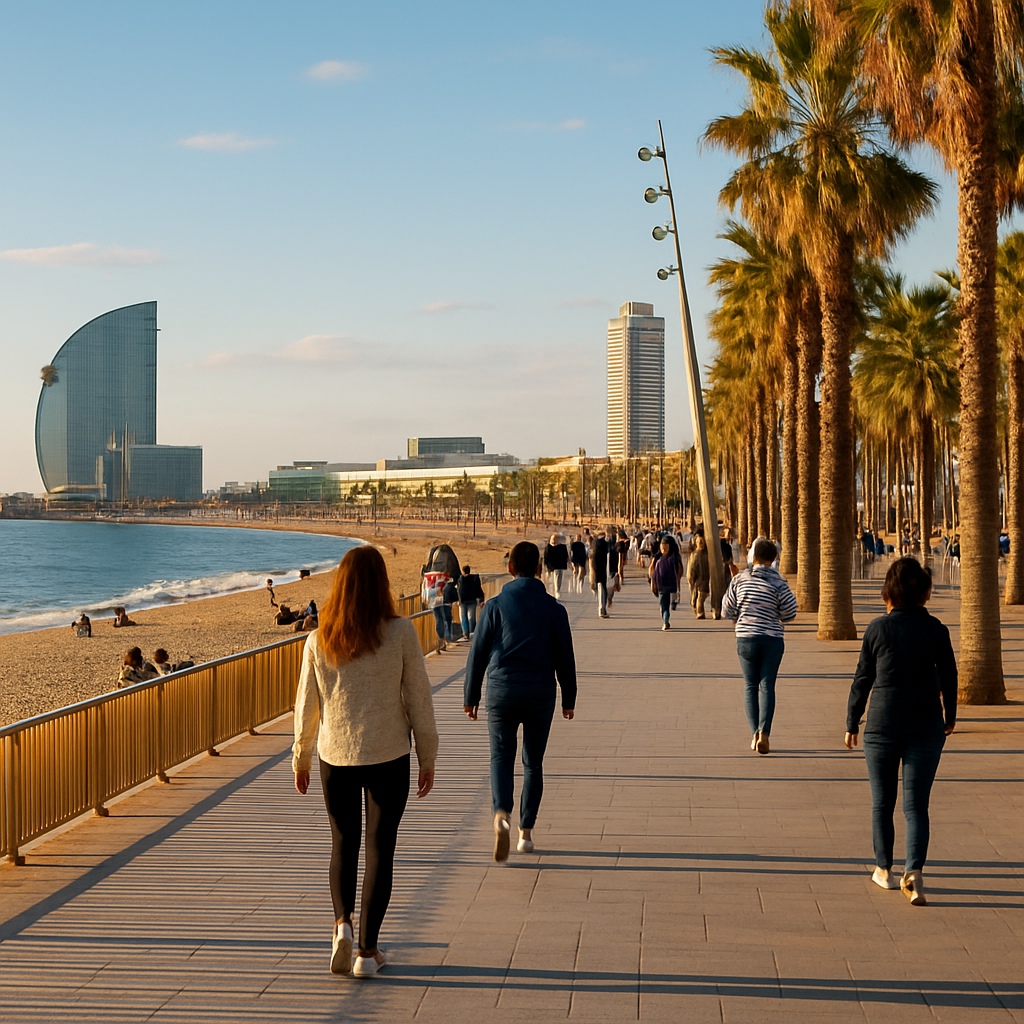
Mar Bella to Barceloneta Beach Walk
Rent bikes or just walk the coastal promenade from Platja de Mar Bella south to Barceloneta — it's about 3 km of Mediterranean waterfront, outdoor sculpture, and the particular Barcelona talent for making a beach feel like an extension of the city rather than an escape from it. Mar Bella's nudist section is at the north end; Barceloneta gets progressively more family-oriented as you move south. Stop for a clara (beer with lemon soda) at one of the chiringuitos along the way.

Park Güell at Opening Time
Gaudí's mosaic-covered park on the hillside above Gràcia is best experienced at 9:30am when the gates open and the tour buses haven't arrived yet. The monumental zone — the famous serpentine bench, the dragon staircase, the hypostyle hall — requires a timed ticket (around €10), but the surrounding park and forest are free and offer some of the best views of Barcelona's grid stretching to the sea. Get there early, bring coffee, and give yourself an hour before the crowds take over.

Sitges Day Trip by Train
Forty minutes on the Rodalies R2 Sud from Passeig de Gràcia and you're in one of Europe's most established LGBTQ+ beach towns. Sitges is a whitewashed coastal village with dedicated gay beaches, queer-owned bars lining the seafront, and a February Carnival that rivals anything on the continent. Even if you skip the nightlife, the light alone — golden and coastal in a way that inland Barcelona can't match — makes it worth the €10 round trip. Have lunch at a seafront restaurant, walk the old town, catch a late afternoon train back. Best day trip in Catalonia, no contest.
The places I actually send people to
Advice that fits how you travel
Barcelona is one of the easiest cities in Europe to do solo — the culture here is built for lingering, for late meals at a counter, for striking up conversations at a bar where nobody expects you to be anywhere else. The apps are active (Grindr, Scruff, and Wapo all have strong local user bases), but honestly you won't need them if you just show up to Plata Bar or Punto BCN on any given evening and stay long enough to make eye contact with a bartender. The crowd in Gayxample is a genuine mix of locals and travelers, and the international energy means English gets you surprisingly far.
Safety solo is excellent in central Barcelona. Gayxample, El Born, Gràcia, and Barceloneta are all comfortable walking neighborhoods at any hour. The real solo-traveler threat is pickpocketing, not hostility — keep your phone in a front pocket on the Metro and at clubs, and don't leave a bag on the back of a chair at a terrace café on Las Ramblas. Common sense, applied consistently.
Budget-wise, solo Barcelona is very doable. A hostel dorm or budget guesthouse runs €25–€35/night, the menú del día lunch special (three courses, bread, drink) is available at restaurants across the city for €12–€16, and the T-Casual metro card covers ten rides for about €12. At a moderate budget of €150–€200/day, you're eating well, seeing Gaudí, and going out at night without counting euros. The city rewards the solo traveler who walks — Barcelona's grid system means you're rarely lost, and the best discoveries happen on foot between planned stops.
Barcelona is one of those rare cities where romance doesn't require any special effort on your part — the city does the work. Walk Passeig de Gràcia at golden hour, find a table at a wine bar in El Born, and let the evening take shape. Same-sex couples move through virtually every neighborhood here without a second glance, and the city's warmth toward affection in general means you'll never feel like you're performing visibility.
For a proper date night, skip the obvious tourist-trap restaurants along Las Ramblas and head to Gràcia instead — the streets around Carrer de Còrsega have exactly the kind of neighborhood restaurants where the pasta is made that morning and the wine list is serious but the atmosphere isn't. If you're splashing out, the dining at Hotel Arts Barcelona is genuinely world-class. For something more low-key and genuinely local, do a Sunday vermut crawl through Gayxample starting around noon — unhurried, sociable, and romantic in a way that a candlelit dinner rarely is.
The most memorable couples experience in Barcelona might be the simplest: rent bikes, ride along the seafront from Barceloneta to Platja de Mar Bella, find a spot on the sand, and do absolutely nothing for two hours. Barcelona rewards that kind of surrender. The city budget for couples runs €250–€340/day at a comfortable moderate level, though you'll find it very easy to spend more if you let yourself.
As of 2026, Spain has some of the most comprehensive legal protections for LGBTQ+ families in Europe — same-sex adoption is fully legal, and both parents on a same-sex couple's registry are recognized equally under Spanish law. In practical terms, Barcelona treats LGBTQ+ families with the same matter-of-fact normality it extends to everyone else. You'll see queer families in Gràcia, at Parc de la Ciutadella, and at the Aquàrium without anyone making it a moment.
Kid logistics in Barcelona are genuinely manageable. The metro runs strollers without issue (though the older Gothic Quarter streets are cobblestoned and narrow — a compact stroller or carrier is smarter than a wide travel system). Children under 4 ride the metro free. The Parc de la Ciutadella has a boating lake, wide paths, and a zoo adjacent — it's an easy half-day that costs almost nothing. The Sagrada Família is worth doing with older kids who can handle the scale; the tower access is genuinely awe-inspiring for children and adults alike, though book tickets months in advance.
Restaurants across the city accommodate children easily — menus del día almost always include simpler options, and Barcelona's café culture means you're rarely rushed. The beach at Barceloneta is family-central in summer, with calm water and a promenade of food vendors. A moderate family budget runs €350–€470/day including accommodation, activities, and a mix of eating out and self-catering. Renting an apartment rather than a hotel room makes a meaningful practical difference with kids in tow.
What Barcelona actually costs
Flights, visas, and the first 30 minutes
Airport: Barcelona–El Prat Josep Tarradellas Airport (BCN) is one of Europe's busiest hubs, with direct service from 200+ cities. From London Heathrow, you're looking at approximately 2h 15m. From New York JFK, approximately 8h 30m. Paris CDG is a short 1h 50m hop, Amsterdam AMS around 2h 10m, Toronto YYZ approximately 9h, and Sydney around 24h via a connecting hub.
Visa requirements (as of 2026): US, Canadian, and Australian passport holders typically do not need a visa for stays up to 90 days within the Schengen Area, but should be aware that the ETIAS travel authorization system is expected to launch mid-2026 — check your government's travel advisory before you book. UK passport holders generally don't need a visa either, but your passport must be valid for at least 3 months beyond your planned departure date — a post-Brexit quirk that still catches people out. EU citizens have freedom of movement with no restrictions. Always verify current entry requirements with your government's official advisory before travel.
Airport to city: The Aerobus (A1/A2) is the easiest option — €6.75 one-way, running to Plaça de Catalunya in 35–40 minutes with frequent departures. The Metro L9 Sud costs €5.15 (with airport supplement) and takes 40–55 minutes, requiring a transfer for central stops. Renfe train R2 Nord is the cheapest at €4.60, reaching Passeig de Gràcia or Sants in 25–30 minutes, but requires a walk or shuttle to Terminal 2. Taxis and rideshares (Cabify, Uber) run €30–€45 and take 20–35 minutes in normal traffic — worth it if you're arriving with luggage or late at night.
Traven's seasonal breakdown
The questions everyone asks
Do I need to speak Spanish or Catalan?
Is it safe to hold hands in Barcelona?
How much should I budget per day?
When do the clubs actually open?
Is the Sagrada Família worth the hype?
Should I visit Sitges as a day trip or stay overnight?
What's the pickpocketing situation really like?
Screenshot this before you go
So should you actually go?
Go. I mean that with no qualification. Barcelona is one of the most complete LGBTQ+ travel destinations on the planet — full legal equality, a queer district that actually functions as a real neighborhood, world-class food and architecture that have nothing to do with your sexuality and everything to do with why this city stays in your head for years. Whether you're here for a massive Circuit Festival weekend or a solo week of Gaudí and cava and quiet afternoons in Gràcia, this city meets you exactly where you are. I gave it a 10.0 on Destination because it earns it on every axis: the beach, the culture, the food, the light. The queerness isn't a layer on top — it's woven into the fabric of a place that decided a long time ago that life is too short and too warm to waste on judgment.
Sources & Resources
Official links we reference when compiling this guide. Last verified 2026-03-04.
- Casal Lambda – LGBTQ+ Community Center Barcelona
- Ajuntament de Barcelona – Oficina per la No Discriminació (LGBTI Resources)
- BCN Checkpoint – Free STI/HIV Testing & Sexual Health Services
- ACEGAL – Association of LGBTQ+ Businesses of Catalonia
- Pride Barcelona – Official Pride Organization
- Stop Sida – HIV Prevention & Support Organization
- ACATHI – LGBTQ+ Refugees & Asylum Seekers Support
- FELGTBI+ – Spanish Federation of LGBTI+ Organizations (National)
- Front d'Alliberament Gai de Catalunya (FAGC)
- Barcelona Turisme – Official LGBTQ+ Travel Guide