
Sedona doesn't argue for your attention — it just waits on the Cathedral Rock saddle at sunrise and lets the light do the rest.
Sedona doesn't have a gay bar. It has something weirder and, honestly, more charming — a whole town that operates on a frequency of radical openness because the people who live here largely arrived by choosing to, not by defaulting to. The crystal-shop owner on Highway 179 will sell your husband a labradorite pendant and invite you both to a sound bath on Thursday without performing any welcome at all. That's the tell. When acceptance doesn't announce itself, you're somewhere worth being.
The landscape does half the work. Red rock walls don't care who's holding whose hand at the Cathedral Rock saddle at sunrise, and once you've watched the Verde Valley light up in that specific orange that no camera filter invented, neither does anyone standing up there with you. There's a reason I landed on an 8.1 for Sedona overall — I gave it a 9.0 on Destination, because the setting is genuinely unlike anywhere else in the Southwest, and because the arts-and-wellness infrastructure that's grown up around it has quietly become one of the Southwest's most functional LGBTQ+-welcoming ecosystems without ever calling itself that.
Now the adult conversation. My Pulse score for Sedona is a 4.0, and that number is the truth. This is a town of roughly 10,000 people in a state whose legislature has been doing real damage to trans healthcare access as of 2026, and you'll feel that second thing more if you're traveling with trans family members than if you're not. Sedona itself punches way above its weight — the metaphysical community, the Dahl restaurants in West Sedona, the staff at Enchantment Resort and L'Auberge de Sedona who have clearly hosted enough same-sex weddings to know what they're doing — but it sits inside a state that hasn't done the legal work. Both things are real at the same time.
What that means practically: you come here for the red rocks, the quiet, the spa at Mii Amo, the sunset table at Mariposa, the cobblestone afternoon at Tlaquepaque Arts & Shopping Village, and the 45-minute drive to Flagstaff the one night you want a real bar. You don't come here for a scene. Once you accept that trade, Sedona becomes one of the more unexpectedly restorative places I've spent a week in recent memory — and one of the few where I've genuinely not wanted to leave.
The stuff your travel guide buries on page 47
Let's separate Sedona from Arizona, because the two don't always move at the same speed. As of 2026, same-sex marriage is legal nationwide in the United States, joint adoption is recognized, and federal employment protections under Bostock v. Clayton County (2020) cover sexual orientation and gender identity. That's the floor. The ceiling is where Arizona gets complicated — the state lacks comprehensive statewide anti-discrimination protections in public accommodations, and recent legislation has restricted gender-affirming care for minors. Groups like Lambda Legal and the Human Rights Campaign track the moving pieces in real time, and I'd glance at their Arizona pages before you pack.
Now, Sedona itself. This is a small arts-driven town inside a politically patchwork state, and it punches well above its legal weight. The metaphysical scene — the crystal shops, the vortex guides, the sound-healing studios — typically reads as explicitly affirming, and the Center for the New Age on Highway 179 is as open a walk-in space as you'll find in northern Arizona. A reader told me the Village of Oak Creek (just say VOC) has quietly become home to a number of same-sex homeowners drawn by quieter streets and prices that don't assume you're on a honeymoon.
PDA comfort scales with where you are. Holding hands in Uptown, at Tlaquepaque, or at any of the resorts is genuinely uneventful. In West Sedona's grocery-and-errands corridor, you're fine — just slightly less tourist-buffered. Pro tip: if you're visiting with trans kids and navigating care questions, the National Center for Transgender Equality has current Arizona-specific guidance worth reviewing before the trip. And for broader community infrastructure, Visit Sedona is a useful starting point even if it's not explicitly an LGBTQ+ resource — the tone of the town comes through.
What it actually feels like on the ground
Holding hands in town: Comfortable in Uptown along SR-89A, at Tlaquepaque, and throughout resort grounds — this is the tourist-facing Sedona, and the crowd is international and varied enough that nobody's keeping score. In West Sedona, around the local grocery and strip-mall stretch, it's fine but visibly quieter in terms of queer presence.
Hotel check-in: Same-sex couples generally check in without friction at the resorts covered here. Hilton Sedona Resort at Bell Rock sits under a parent company with a 100/100 Corporate Equality Index score, and L'Auberge de Sedona and Enchantment Resort have hosted enough same-sex weddings that the staff have clearly done the work.
Taxis and rideshare: Lyft and Uber operate but inventory in Sedona is thin — drivers mostly come up from Cottonwood or down from Flagstaff. No reports of identity-based issues. Pre-book airport returns; don't assume an on-demand ride will appear.
Trailheads and Oak Creek Canyon: Popular trails — Cathedral Rock, Bell Rock, Devil's Bridge — draw international crowds and read relaxed for same-sex couples. Early-morning hours skew more locally attended but remain comfortable. Once you venture into rural Yavapai County beyond the town limits, read the room in smaller unincorporated communities.
Late night: Sedona goes to bed early — this isn't a nightlife town. Uptown restaurants wind down by 10 p.m. and West Sedona's local bars are quiet but uneventful. If you want after-hours energy, the drive to Jerome (30 minutes) or Flagstaff (45 minutes) is the move.
Trans travelers: Sedona's social environment is typically warm and affirming — the spiritually-oriented community leans open. But Arizona's legal environment is a different story. Gender-affirming care access at the state level has tightened, and the National Center for Transgender Equality keeps an updated Arizona brief worth reading. For healthcare logistics, Verde Valley Medical Center in Cottonwood is closest, but Flagstaff and Phoenix carry more specialized affirming care.
Health resources: The Arizona Department of Health Services HIV/STI program lists current testing and prevention resources statewide, and for crisis support the Trevor Project operates 24/7.
Verbal harassment risk: Low in town. I haven't seen credible reports of incidents at the resort-and-arts corridor that anchors most visits. Stay aware in unincorporated rural stops between Sedona and the surrounding day-trip towns — not because something will happen, but because it's just not the same insulated bubble.
The queer geography
Uptown Sedona
The main event — a half-mile of SR-89A lined with galleries, Southwestern boutiques, crystal shops, and restaurants all staring directly at the red rock wall to the east. It's touristy in the way Aspen's Main Street is touristy: unapologetic, well-curated, and sunset-lit in a way that borders on theatrical. Grab breakfast before the crowds, walk to the trailhead at the north end, and come back for a cocktail at The Hudson. The Sedona Arts Center, founded in 1958, anchors the cultural end of the strip and rotates exhibitions that draw a reliably mixed, inclusive crowd — openings here are the closest thing Sedona has to a community scene.
Tlaquepaque District
Modeled on the arts quarter of its namesake outside Guadalajara and opened in 1971, Tlaquepaque Arts & Shopping Village is all cobblestone courtyards, hand-carved doors, bell towers, and over 40 galleries and boutiques tucked into a shaded sycamore-lined complex on SR-179. Eat at one of the courtyard cafes, wander into a silversmith's studio, cross the street to El Portal Sedona Hotel for a drink. Staff at the galleries and shops are notably welcoming to same-sex couples, and the Día de los Muertos celebration each fall is one of the most genuine community events of the year.
West Sedona
The residential spine along SR-89A west of The Y — quieter, more local, and where you'll find the everyday grocery runs and long-term residents, including a visible LGBTQ+ contingent. This is also where chef Lisa Dahl's empire lives: Dahl & Di Luca for the Southern Italian fine-dining institution she opened in 1995, and Mariposa Latin Inspired Grill on the hillside for the wood-fired asador and the kind of red-rock views that make the drive worth it on their own. Dahl's group is specifically cited in LGBTQ+ travel guides for a reason — the staff reads every table the same way.
Boynton Canyon
Drive 15 minutes west of Uptown and the tourist hum drops away entirely. The canyon walls close in, the light softens, and you understand why the Yavapai and Apache peoples consider this ground sacred. Enchantment Resort and its destination spa Mii Amo sit at the canyon's head — both have become quiet favorites for same-sex weddings and honeymoons, partly for the backdrop and partly because the staff have very clearly done the work. Book the Visit Sedona-listed Boynton Canyon Trail early in the morning; you'll have the vortex overlook mostly to yourself.
Village of Oak Creek (VOC)
Six miles south of Uptown on SR-179, past Bell Rock and Courthouse Butte, VOC is Sedona's quieter, more affordable alter ego — suburban in character, with golf-course resorts and a growing number of same-sex homeowners who wanted proximity to Sedona without the daily tourist churn. It's slightly more conservative than Uptown but entirely uneventful for visible couples, and Cucina Rustica — another Lisa Dahl restaurant — is worth the drive for the hacienda-style room alone. For broader community infrastructure and Pride programming, the 45-minute drive to Flagstaff Pride and the regional PFLAG chapter is the route most Verde Valley residents take.
The experiences worth rearranging your itinerary for
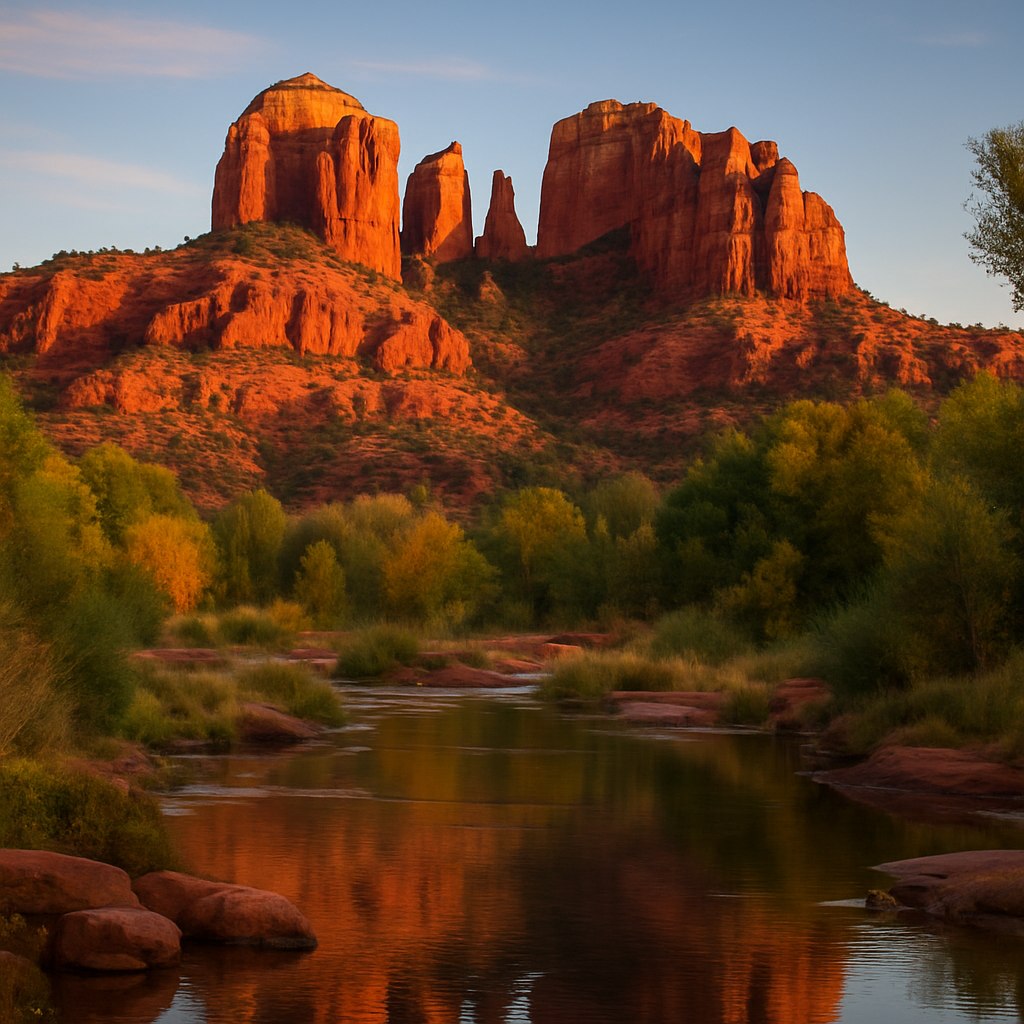
Cathedral Rock at Sunrise
Set an alarm you'll resent and drive to the Back O' Beyond trailhead before the sky starts moving. It's a short hike — barely 1.5 miles round-trip — but the last quarter-mile is a scramble up slickrock that uses your hands, and you'll want the cool air for it. At the saddle, the Verde Valley opens up in front of you and the rocks light up in that specific Sedona orange you've seen in photos and assumed was filtered. It wasn't.
The trail is popular enough with international hikers that nobody is cataloguing who you're with at the top. Bring water, bring grippy shoes, and don't try this one in the dark unless you have a proper headlamp.
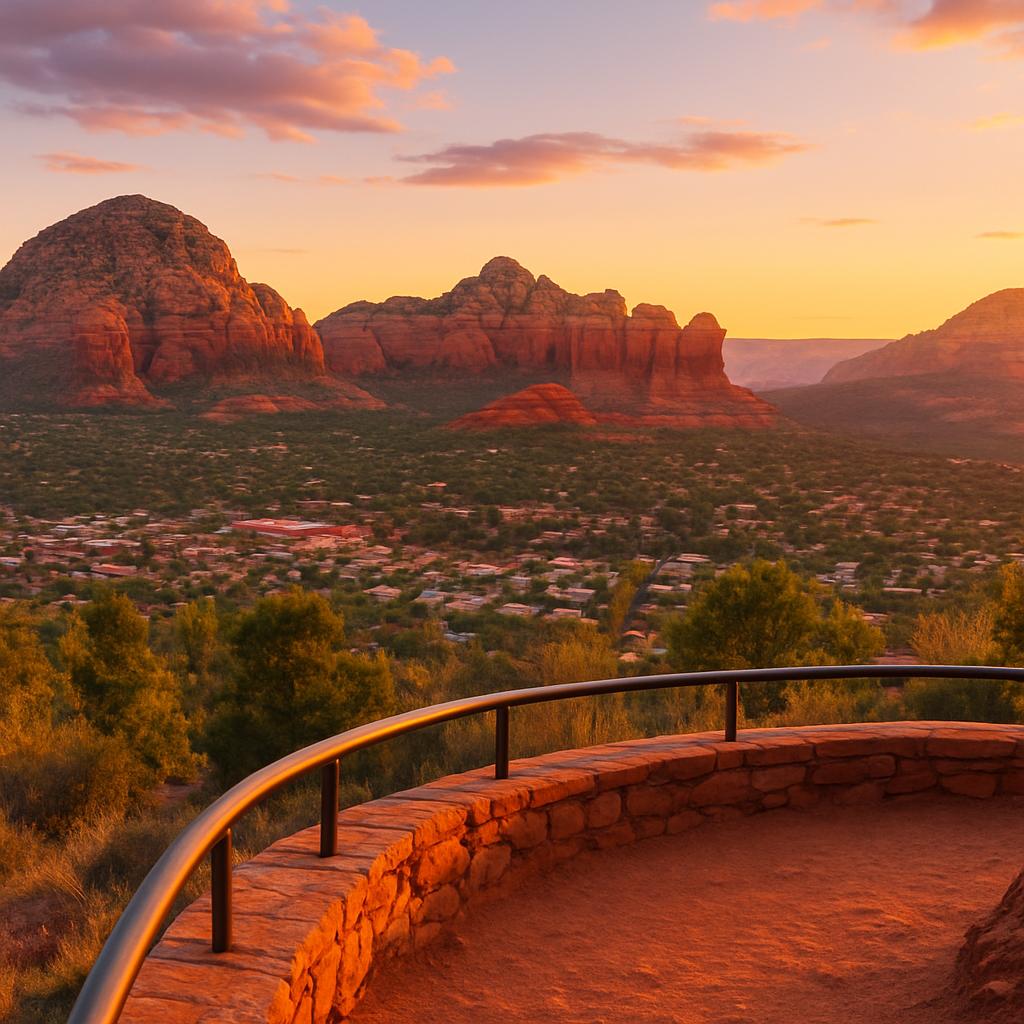
Airport Mesa at Sunset
Sedona's unofficial communal ritual: drive up to the overlook on Airport Road about an hour before sundown, park, walk out to the rocks, and watch strangers from forty countries do the exact same thing at the exact same time. The 360-degree panorama covers Bell Rock, Courthouse Butte, Cathedral Rock, and the whole red rock amphitheater west of town, and the light does genuinely surreal things in the last fifteen minutes of the day.
It's free, it's overwhelmingly accepting, and it's the closest thing Sedona has to a public square. Bring a layer — once the sun drops, the temperature does too.
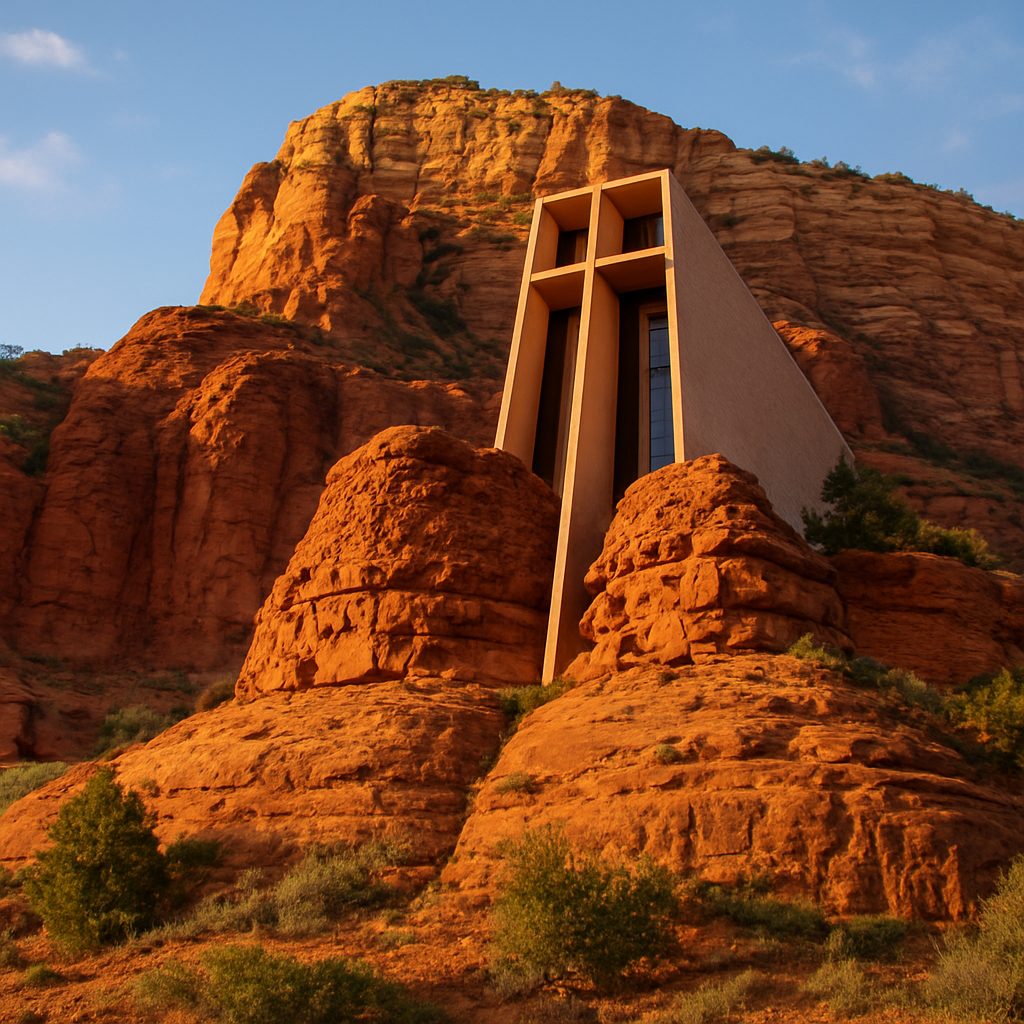
Chapel of the Holy Cross
Marguerite Brunswig Staude's 1956 chapel is built straight into a 250-foot butte in southeast Sedona, and it's a genuinely moving piece of mid-century ecclesiastical architecture regardless of whether you've set foot in a church in a decade. The drive up is short, the walk from the lower parking lot is steep, and the view from the chapel's forecourt is arguably the best engineered vista in town — Bell Rock and Courthouse Butte framed like a painting.
Over a million people visit a year. Go early or go late; midday the lot is a scrum.
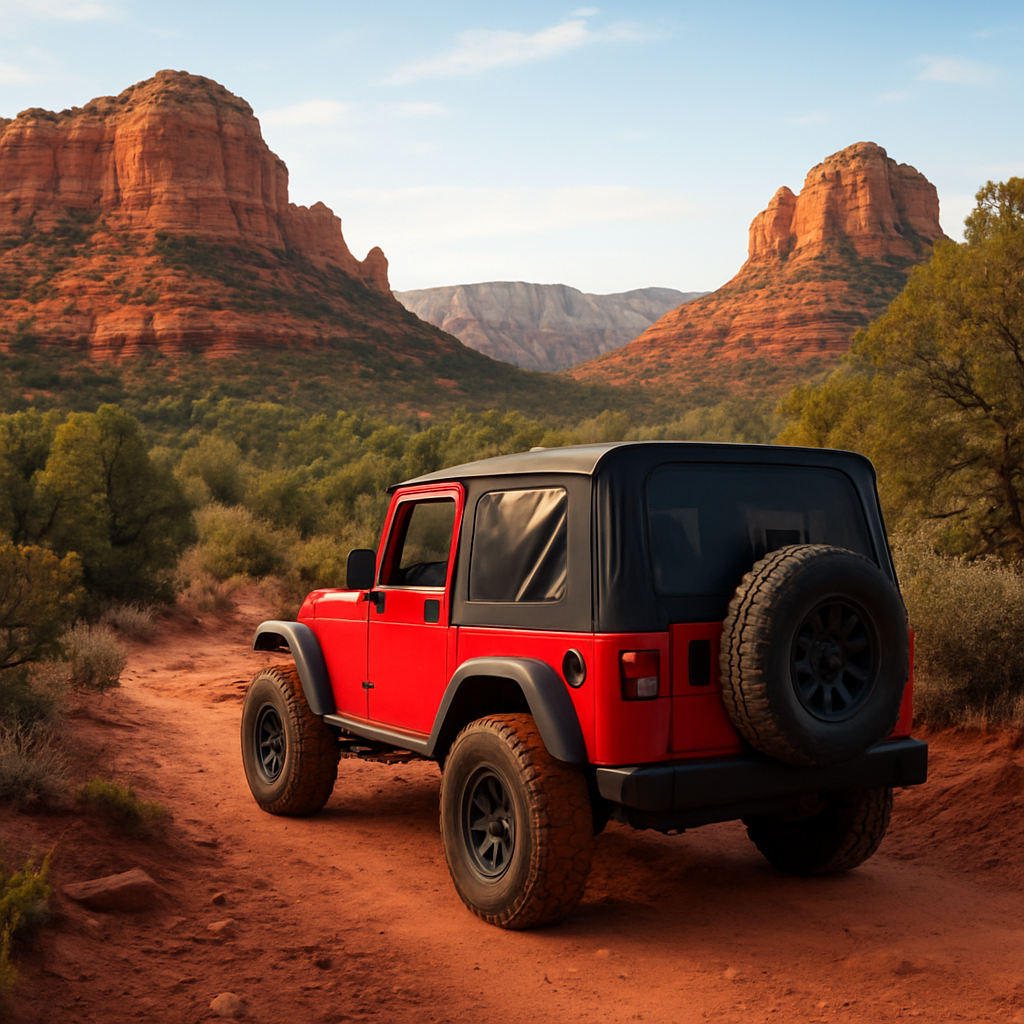
A Pink Jeep Tour Up Broken Arrow
It sounds like the touristy thing you'd never do until you're strapped into an open-air Jeep climbing over slickrock at an angle your stomach doesn't agree with, and suddenly you understand the appeal. Pink Jeep Tours has been running since 1960 — the longest-operating outfit in town — and the Broken Arrow route remains the signature: Devil's Dining Room, Submarine Rock, Chicken Point, each stop more ridiculous and beautiful than the last.
Ninety minutes to a full day depending on the route you pick. Book the morning slot in summer before the heat climbs.
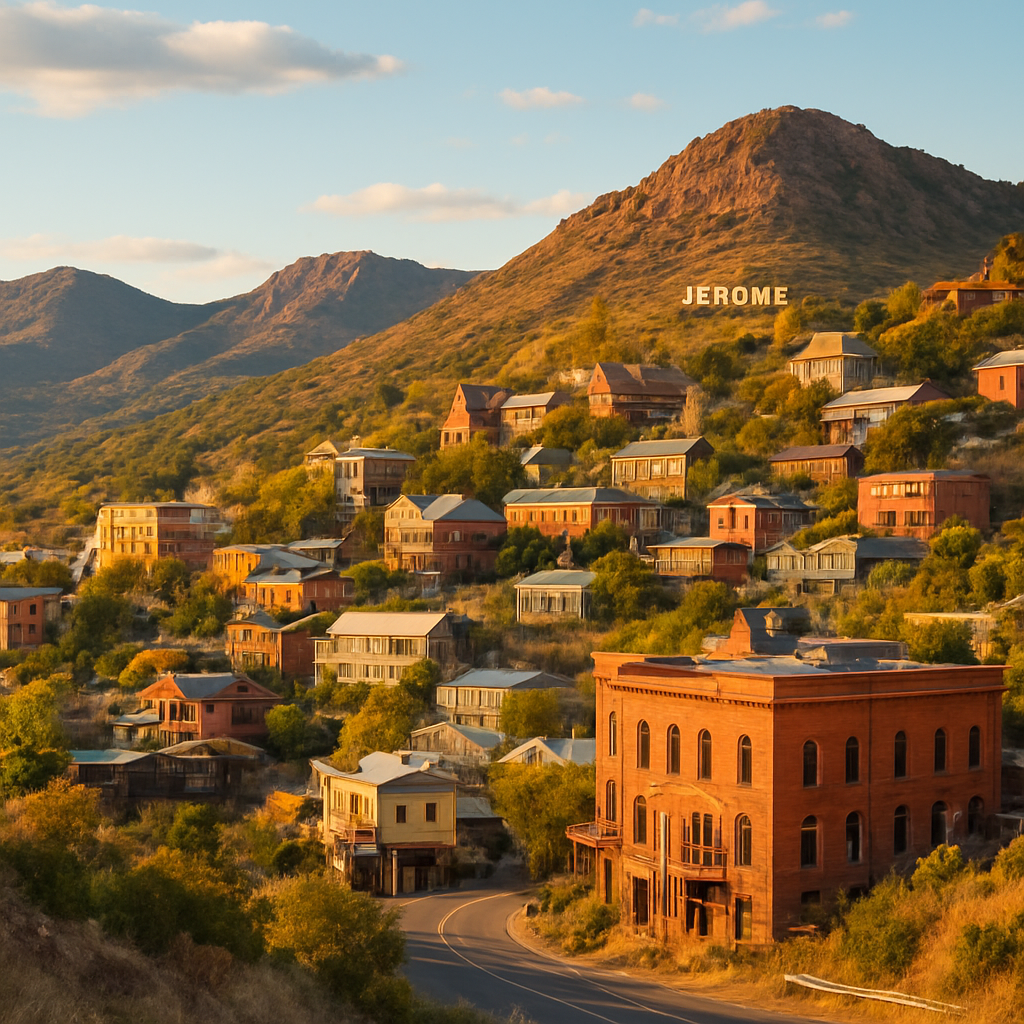
A Day in Jerome
Thirty-five miles southwest of Sedona, clinging to a 5,000-foot mountainside like it's negotiating with gravity, Jerome is the copper-mining ghost town that artists resurrected in the 1970s and never quite let return to normal. Spend the afternoon walking the switchback streets of the historic district, stop into Caduceus Cellars for a tasting from Maynard James Keenan's Arizona vineyard, and end at The Spirit Room in the Connor Hotel for a drink under a ceiling that's seen a hundred years of mining-camp evenings.
The views across the Verde Valley on the drive down are, honestly, absurd. Give yourself the full day.
The places I actually send people to
Advice that fits how you travel
Sedona as a solo traveler is a different proposition than most people expect. The town runs almost entirely on couples and retreat energy, which means you're often paying a double-occupancy rate you're eating alone. The workaround is the Matterhorn Inn on Oak Creek — one of the few places in Uptown Sedona that starts around $120/night — and its location puts you within walking distance of trailheads, the SR-179 restaurant corridor, and the Sedona Arts Center. Budget $155–195/day if you're watching it; that covers a real room, a real dinner, and an activity without stretching.
The social infrastructure for meeting people is low-key but genuine. Gallery openings at SAC draw a mixed, reliably open-minded crowd — I've had better conversations at Tlaquepaque gallery events than at most bars I've tried to navigate in small towns. The app situation is what you'd expect from a community of about 10,000: thin but not empty, leaning heavily toward visitors rather than locals. If you want a real scene — gay bars, an actual crowd, people who live there and go out — Flagstaff is 45 minutes north via US-89A and has a Northern Arizona University-anchored community worth the drive. Flagstaff Pride runs an annual event worth timing a trip around if you're in the region.
Solo safety is genuinely not a concern in the Uptown and resort zone. The international tourist crowd and arts community around you trend open-minded, and the worst you'll realistically deal with in town is general indifference to your existence. A specific note for trans solo travelers: Sedona's social environment reads warm, but Arizona's legislative environment is a different matter — I'd review what the National Center for Transgender Equality has posted on Arizona-specific guidance before you pack, and bookmark One n Ten for statewide affirming resources and referrals. Their lists cover adults, not just the youth programming they're known for.
Same-sex couples are genuinely visible at Sedona's resort and arts corridor level, and PDA at Tlaquepaque, Uptown Sedona, and on the resort grounds is about as unremarkable as it gets anywhere in the Southwest. The question isn't whether you'll feel comfortable — you will — it's which version of comfortable you want to spend your money on. Adobe Grand Villas gives you seven individually themed suites with private fireplaces and jetted tubs starting around $350/night, adults-only, no explanations required. L'Auberge de Sedona puts you directly on Oak Creek in a AAA Four Diamond property with Etch Kitchen & Bar when you don't feel like driving anywhere. Enchantment Resort in Boynton Canyon has hosted enough same-sex weddings at this point that the staff have clearly made a decision about who they want to be, and it shows from the moment you hand over your ID at check-in.
For the actual date itinerary: set an alarm you'll resent and drive to Cathedral Rock before the sky starts moving, spend the afternoon wandering the cobblestone courtyards of Tlaquepaque, and book a table at Mariposa Latin Inspired Grill for golden-hour dinner on the hillside — Lisa Dahl's wood-fired asador, panoramic red rock views, and a staff that gives zero thought to who you're holding hands with across the table. End the evening at Cress on Oak Creek at L'Auberge if you're staying nearby. A drink at the water's edge while Oak Creek runs three feet from your table is one of the more romantic things I've done in any state, and I won't apologize for saying so.
Wellness and spa culture is Sedona's unofficial couples activity, and Mii Amo at Enchantment Resort is the apex of it — repeatedly named a top U.S. destination spa by Condé Nast Traveler, with day-use treatments and multi-day residential packages both available. Book well in advance; holiday weekends fill fast. At a slightly more accessible entry point, Amara Resort and Spa in Uptown has an outdoor pool overlooking Oak Creek and a full-service spa where same-sex couples book without drama. Both properties have appeared in LGBTQ+ romantic travel features for a reason that goes beyond the red rock backdrop.
LGBTQ+ families are on solid legal footing when traveling to Sedona as of 2026 — same-sex marriage is federally recognized, joint adoption is legal nationwide, and most Sedona businesses operate with the baseline assumption that visitors arrive in all configurations. Families with two moms or two dads register as genuinely unremarkable at the resort properties, at Tlaquepaque, and throughout the outdoor recreation circuit. One important flag if you're traveling with trans youth: Arizona has enacted restrictions on gender-affirming care for minors, and families navigating that should understand the landscape before they arrive. The National Center for Transgender Equality maintains current Arizona-specific guidance, and One n Ten — Arizona's dedicated LGBTQ+ youth organization — has statewide resources and referrals worth bookmarking before the trip.
On the ground, kids genuinely do well here. Pink Jeep Tours departs from Uptown and the Broken Arrow route converts even the most screen-addicted twelve-year-old — book the morning slot in summer before the heat climbs, and plan for 90 minutes to a half-day depending on the route. Airport Mesa at sunset is free, accessible at the overlook level, and draws the kind of international crowd that makes kids feel like they're part of something bigger than your minivan. Tlaquepaque is walkable, mostly flat, and genuinely engaging for kids old enough to have opinions about art; the annual Día de los Muertos festival in late October is particularly worth timing a trip around. For a morning fuel stop before any hike north of town, Indian Gardens Cafe & Market in Oak Creek Canyon — about four miles up from Uptown — handles breakfast and packed sandwiches both.
Logistics: a car is non-negotiable in Sedona, which has no public transit whatsoever, and you'll want cargo space for strollers, hiking gear, and whatever Tlaquepaque inevitably does to your shopping restraint. Kids' menus exist at most major resort restaurants and at Coffee Pot Restaurant in West Sedona, which has been feeding families since 1950 and lists 101 omelets for the kid with extremely specific breakfast opinions. The Hilton Sedona Resort at Bell Rock in the Village of Oak Creek is the most family-practical pick on this list — full-service amenities, multiple pools, direct Bell Rock and Courthouse Butte views, and a parent company with a 100/100 HRC Corporate Equality Index score. That last detail matters when you're traveling with a family that doesn't want to wonder about the welcome.
What Sedona actually costs
Flights, visas, and the first 30 minutes
Sedona doesn't have a commercial airport — you're flying into Phoenix Sky Harbor International Airport (PHX), roughly two hours south by car. That drive north on I-17 and then up SR-179, watching the landscape shift from flat desert scrub into towering red rock canyon, is its own arrival sequence. Factor it in as part of the trip, not an inconvenience.
Rental car is the only genuinely practical option — Sedona has no public transit, full stop, and you'll want the freedom to reach trailheads at dawn, drive out to Boynton Canyon, and make the run down to the Verde Valley wine country without negotiating a rideshare. Budget $40–80/day and book well in advance during spring and fall peak season. The Arizona Shuttle offers shared door-to-door service from PHX at around $55–70 per person one-way — door-to-door, advance booking strongly recommended. If you need a private transfer, expect $160–220 one-way; Lyft and Uber operate from PHX but return availability from Sedona is genuinely thin, so pre-book both directions before you leave home.
Entry requirements as of 2026: US citizens — domestic travel, nothing required. Canadian citizens typically need a valid passport or NEXUS card; no visa required. UK, Australian, and most EU nationals are generally eligible for the Visa Waiver Program via ESTA ($21 USD); apply at least 72 hours before departure at the official CBP website. Citizens of countries outside the VWP will typically need a US tourist visa obtained in advance — check with the US Embassy in your home country for current requirements and processing times.
PHX is one of the most connected airports in the Southwest, with service from most major US hubs and a reasonable number of international routes via connecting cities. If you're routing in from the West Coast, the drive from Las Vegas via I-40 and SR-89A through Ash Fork runs about 4.5 hours and opens up the option of a Grand Canyon night if you want to extend the trip. From Los Angeles, the drive through the Mojave via I-10 and I-17 is roughly six hours — doable as a single push or a scenic overnight through the desert.
Traven's seasonal breakdown
The questions everyone asks
Is Sedona safe for same-sex couples?
Does Sedona have gay bars?
Do I need a rental car?
When is the best time to visit?
Is Sedona welcoming to LGBTQ+ families?
How much should I budget per day?
Is it worth timing a visit to Pride?
Screenshot this before you go
So should you actually go?
Go. Sedona earns the 8.1 — it's the red rocks, yes, but it's also the unassuming warmth of an arts town that figured out inclusivity decades before that became a marketing term. LGBTQ+ travelers will find resorts that have clearly done the work, restaurants where the staff read every table the same way, and a landscape that does something to your nervous system that's hard to explain until you've stood on Cathedral Rock at dawn. Come with realistic expectations — this is wellness and wilderness, not nightlife — and if you're traveling with trans family members, do your homework on Arizona's current legislative landscape before you book. For everyone else: rent the car, book the spa, set the alarm you'll resent, and give the town four days minimum. You'll leave planning the return trip.
Sources & Resources
Official links we reference when compiling this guide. Last verified 2026-04-14.
- Arizona Department of Health Services – HIV/STI Resources
- Flagstaff Pride
- Human Rights Campaign
- Lambda Legal
- National Center for Transgender Equality
- One n Ten (LGBTQ+ Youth Arizona)
- PFLAG – Find a Chapter (Flagstaff/Verde Valley)
- Rainbow Youth Project USA
- Trevor Project
- Visit Sedona – Official Tourism Bureau